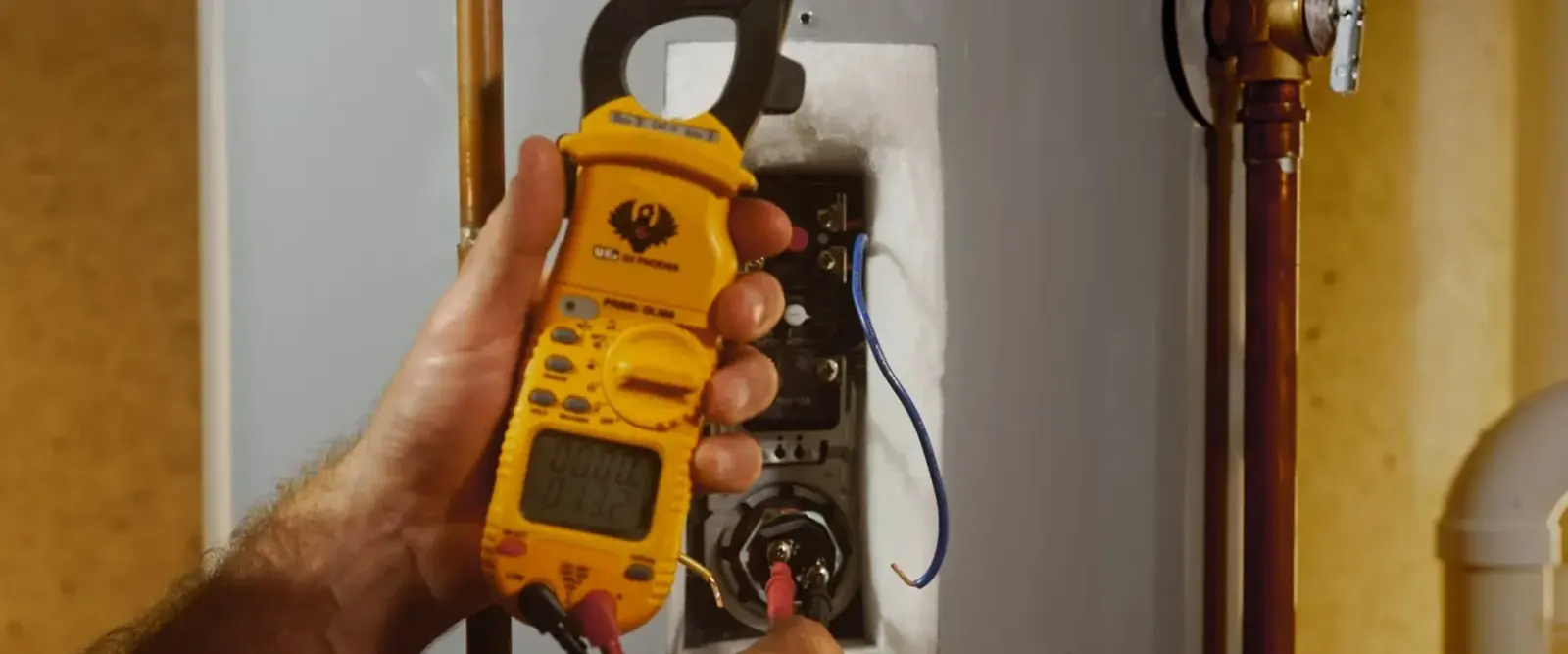
No hot water now: quick checks before you call
Emergency water heater repair means getting hot water back or stopping damage when a tank fails. Dispatch is open 24/7, with same-day visits when a plumber is open. If water is on the floor, close the cold supply valve on top of the tank and keep reading.
Before you call about a cold tank, run through these checks. They take a few minutes and sometimes solve the problem.
- Electric heater: check the breaker for the heater. If it tripped, reset it once. If it trips again, stop and call, because something is shorted.
- Gas heater: look at the pilot light or the display. If the pilot is out and you smell no gas, follow the relighting steps on the label. If you smell gas, use the safety steps below instead.
- Reset button: many units have a red high-limit button behind a cover. Press it once only.
- Gas valve and thermostat: make sure the gas control is on and the temperature dial has not been bumped to a low setting.
If the water is warm but not hot, or hot only for a few minutes, a failed heating element or a sediment layer is likely. The plumber checks both.
Gas smell near the heater: leave first
If you smell gas, leave the building immediately and move at least 350 feet away. Do not switch lights on or off, ring doorbells, start a car or use a phone near the odor. Once you are at a safe distance, call PSE&G at 1-800-880-PSEG (7734) or 911. Reporting a gas leak costs nothing. Call us only after the utility says the area is safe.
Water heater leak: where the water is coming from
A puddle under the heater has three common sources, and the fix depends on which. Look closely, because a loose fitting is a small repair and a leaking tank is not.
| Source | What you see | What it usually means |
|---|---|---|
| Tank body | Water seeping from the base or sides, or rust streaks | The steel tank has corroded through. Replacement, not repair. |
| Fitting or connection | Drips at the cold inlet, hot outlet or drain valve | A loose or worn connection. Often a repair. |
| Relief valve or discharge pipe | Water from the valve or the pipe attached to it | High pressure or temperature, or a worn valve. Needs diagnosis. |
If the tank itself is leaking, shut the cold water supply, turn off the power or gas, and drain a few gallons if you can safely reach the valve. Turn off electricity only if you can reach the breaker without standing in water. A tank that has failed cannot be patched, and our water heater replacement page explains the next step.
A relief valve that drips is a warning, not a nuisance. Never cap it or plug the discharge pipe, because it exists to prevent a pressure buildup. Call and describe what you see.
Gas, electric and hybrid heat pump heaters compared
| Type | Common failures | How repair differs |
|---|---|---|
| Gas tank | Pilot or igniter, thermocouple, gas control valve, burner, venting | Combustion parts need careful testing and a venting check |
| Electric tank | Heating elements, thermostats, high-limit switch, wiring | Parts are simpler, and power must be off before opening panels |
| Hybrid heat pump | Fan, compressor, condensate drain, sensors, plus the backup element | Needs refrigerant-side know-how and clear airflow |
Gas models fail more often at the ignition and venting end, while electric ones fail at elements and thermostats. Hybrid heat pump heaters add a fan and compressor, which is why they cost more to service. If yours is a hybrid, tell dispatch so the plumber arrives prepared.
Common parts we repair or replace
- Thermostat: controls temperature. A bad one gives lukewarm water or scalding water.
- Heating element: the electric coil in the tank. One burns out and the water runs short.
- Burner and igniter: on gas tanks, the parts that start and hold the flame.
- Anode rod: a sacrificial metal rod that protects the tank from rust. Replacing it can extend tank life.
- Relief valve: the safety valve that opens if pressure or heat climbs too high.
These are the parts most repairs touch. If the tank is sound, replacing the right part brings the heater back for much less than a new unit.
When repair stops making sense
A repair is smart when the tank is sound and the failed part is small. It makes less sense when the tank leaks, when several parts have failed in a short time, or when the heater is near the end of its life. Ask the plumber how old the unit is by reading the serial number, and whether the repair costs more than a share of a new one.
If the answer points toward a new unit, water heater replacement covers what to expect. For those who want endless hot water and a smaller footprint, tankless water heater installation is another route.
Apartments, two-family houses and central boilers
Union City's housing includes two-family homes, brownstones and apartment buildings, and each may have its own heater setup. A unit with its own tank is the tenant's or owner's repair. A building with a central boiler that feeds hot water to every apartment is a different system, and the owner or super handles the call.
If the whole building has no hot water, ask whether it runs on a central boiler. In that case, see boiler repair and tell the super first. If only your unit is cold and the tank is in your closet, call us.
What drives water heater repair cost
Pricing follows the part and the labor, and the number is clear before work starts. The usual factors:
Insurance seldom covers a worn-out heater, but sudden water damage from a leak may be covered. Photograph the area, shut off the supply and call your insurer before cleanup.
Want your real number? Call and describe the job.
Call (551) 249-3045What happens on a repair call
Sudden hot water loss usually points to one failed part.
Tell us the symptom
Cold water, lukewarm, leak or noise, plus the heater type.
Inspect
The plumber checks power or gas, controls and the tank condition.
Repair or advise
You get a clear price for the fix, or an honest word that the tank is done.
Test
The heater runs through a full cycle before the plumber leaves.
Tank leaking or no hot water?
Call the 24/7 line now. Shut the cold supply on a leak and tell dispatch what you see.
Keeping the heater running
Flushing sediment from the tank and checking the anode rod when the plumber is already on site help older tanks last. If a leak damaged a ceiling below, leak detection can find any hidden water. Owners in West New York dial the same number.
Water heater repair questions in Union City
Yes. Nights, Sundays and holidays all reach a live dispatcher, and a plumber is sent as soon as one opens up. Mention a leaking tank so that call moves up the list.
On electric units, a tripped breaker or a bad element is common. On gas units, check the pilot or igniter. If a reset does not help, call.
It can damage floors and ceilings, and a leak near electrical parts is a shock risk. Shut off the cold supply and power if you can do so safely.
A leaking fitting or valve can. A tank that leaks through the steel cannot be patched and needs replacement.
Exit immediately and keep moving until you are 350 feet clear. Then call PSE&G on 1-800-880-PSEG (7734) or dial 911. Skip switches, doorbells and phones until you are away.
The owner or super usually calls. If your unit has its own tank, we can repair it.
Still have a question? A dispatcher answers around the clock.
Call (551) 249-3045Public sources behind water heater repair
According to these official pages, the rules and safety steps mentioned here apply in New Jersey. Check them for your own address, since rules can change.
- New Jersey Department of Community Affairs, Uniform Construction Code general information: permit and inspection rules for plumbing work on existing buildings.
- NJ Division of Consumer Affairs, State Board of Examiners of Master Plumbers FAQ: who may perform plumbing work and what a licensed business must display.
- PSE&G, what to do if you smell gas: the leave-first steps and the gas emergency line.