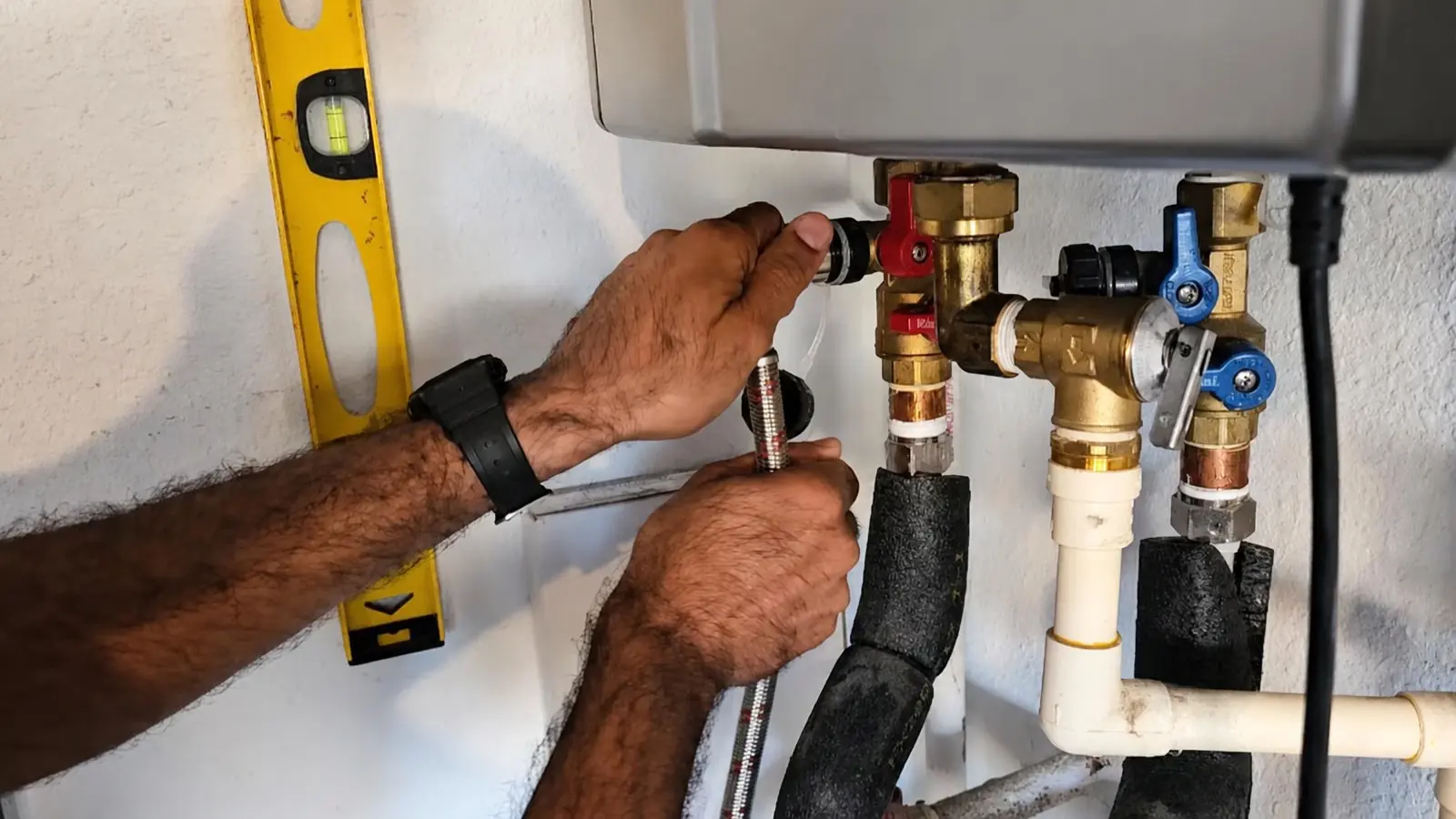
How a tankless water heater works
A tankless water heater heats water only while a tap is open. Cold water enters the unit, runs through a heat exchanger and leaves hot, so there is no storage tank holding gallons at temperature.
The trade-off is flow rate. Every model has a rating in gallons per minute at a set temperature rise, and colder incoming water lowers what the unit can deliver. If two showers and a dishwasher run together, a small unit may fall behind and the water turns lukewarm.
Gas units fire a burner under the heat exchanger and need a vent to carry exhaust outdoors. Electric units use heating elements instead and need no vent, but they pull a large electrical load. Choosing between them starts with what your building can supply, not with the brochure.
Fitting tankless into an older Union City building
Union City has 26,455 housing units, and much of the older stock is brownstones, two-family houses and apartment buildings packed tightly together. That means limited wall space, interior closets and long runs to an outside wall. Each of those decides whether a tankless unit can go where your tank sits today.
What a plumber checks before quoting a swap
Most surprises come from the pipes and vents around the unit, so we look there first.
- Gas line size: a tankless burner can draw far more gas at once than a tank burner, so the old pipe may be too small.
- Gas supply at the meter: ask PSE&G whether the service can carry the added load.
- Venting: gas units need a sealed vent to the outside, and an interior closet may have no short path.
- Electrical capacity: a gas model needs a small outlet for its fan and controls, while an electric model needs a large dedicated circuit.
- Water pressure and pipe condition, since the unit needs steady flow to light.
In a building with several apartments, the owner often decides, because the gas line and vent may serve more than one unit. If you rent, bring your landlord into the conversation before you call. A new installation also touches the work described on our water heater installation page.
Flushing and descaling a tankless heater
Water carries dissolved minerals, and heat pulls them out as scale. Inside a tankless unit, scale coats the narrow passages of the heat exchanger, which cuts flow, raises exhaust temperature and eventually triggers error codes. A unit that once delivered steady heat starts to swing between hot and warm.
A flush clears that scale. The plumber closes the isolation valves, connects a small pump and hoses, and circulates a descaling solution or food-grade vinegar through the exchanger for the time the manufacturer lists. Then the unit is rinsed with clean water, and the inlet filter screen is cleaned.
How often you need it depends on your water and how much you use. Veolia supplies Union City's water, and you can ask Veolia for its annual water quality report or test your tap with a store kit. Follow the interval in your unit's manual, and shorten it if the test shows mineral-heavy water.
If the unit has no service valves, a plumber can add them so every later flush takes less time.
Tankless water heater repair
Tankless units tell you what is wrong through a display. The code points to a system, such as ignition, flame sensing, exhaust, flow or overheating, and your manual lists the meaning for your model. Write the code down before you reset the unit, because a technician uses it to pick the right part.
| Symptom | Common cause | First thing to try |
|---|---|---|
| No hot water at all | Gas off, power off, blocked vent or clogged inlet screen | Check the gas valve and outlet, then call if the display shows a code |
| Hot, then cold, then hot again | Water left in the pipes, or flow too low for the unit to stay lit | Open the tap further and note how long the cold part lasts |
| Temperature keeps changing | Scale in the exchanger or too many fixtures running | Run one fixture and see if it steadies, then schedule a flush |
| Error code on the display | Ignition, flame, vent or sensor fault | Record the code and call before repeated resets |
The cold gap between two bursts of hot water is the classic cold sandwich. It happens when you shut a tap briefly and reopen it, or when the unit needs a minimum flow to relight. A recirculation loop or buffer tank fixes it in some homes. If you have no hot water and need it today, see water heater repair for the urgent path.
Tankless versus tank: which fits your home
| Question | Tankless | Tank |
|---|---|---|
| How is hot water made | On demand through a heat exchanger | Stored and kept hot all day |
| Running out | Never empties, but flow is limited per minute | Empties after a long run, then recovers |
| Space | Small wall unit | Floor space for the tank |
| Install in an older building | Often needs gas, vent or electrical changes | Usually swaps into the existing connections |
| Upfront cost | Usually higher | Usually lower |
| Maintenance | Regular flushing and a clean inlet screen | Periodic tank flush and anode check |
If your tank is failing, compare this table with water heater replacement before you decide. A like-for-like tank swap is often simpler in a building that was never piped for tankless.
When tankless is a poor fit
Tankless is a weak choice when the gas line cannot be upsized, when there is no sensible vent route, or when the panel cannot take an electric model. It also disappoints households that run several showers at the same time without a larger unit.
In a shared building, a central system or an owner's decision may rule it out entirely. A plumber who tells you that on the first visit is saving you money.
Permits and inspections
Replacing a water heater changes gas piping, venting and sometimes electrical work, which the state construction code treats differently from routine repair. Ask the Union City construction office whether your job needs a permit and an inspection, and whether the owner must apply. We can tell you what the plumbing side of the job involves.
What drives tankless water heater cost
The price depends on what the building needs around the unit. We give a clear price before work starts, after the plumber has seen the space.
Insurance rarely pays to upgrade a working heater. If a leaking tank damaged a ceiling, call your insurer about the damage before you repair it, and keep photos and the invoice.
Want your real number? Call and describe the job.
Call (551) 249-3045What happens when you call
Same-day appointments are available when a plumber is free.
Tell us what you have
Give the type, age and location of the current heater and what is going wrong.
Site visit
A plumber checks the gas size, vent route, power and water pressure.
Plan and price
You hear the options, including staying with a tank, and the price before work starts.
Install and test
The unit is set, tested at several taps and left with the flush valves in place.
Ready to talk tankless?
Call (551) 249-3045. Dispatch answers 24/7 and can book a plumber to look at your gas, vent and power.
Related work near you
A tankless install often leads to other checks, such as a leak detection visit if a damp spot sits near the old tank. For wider work on your pipes, see plumbing installation. Owners in West New York have the same dense buildings and ask the same gas and vent questions.
Tankless water heater questions
Often yes, but the gas line, vent path or electrical supply may need work. A plumber has to check all three on site before saying yes.
Follow the interval in your manual, then adjust for your water. Ask Veolia for its annual water quality report or test your tap to see how mineral-heavy it is.
That is the cold sandwich. Water already in the pipes cools, and the unit may shut off at low flow before it relights. A higher flow at the tap or a recirculation setup can help.
It never runs out of stored water, but each model has a flow limit. Too many fixtures at once can still leave you with lukewarm water.
Note the code and check that gas and power are on. Call before resetting several times, since repeated lockouts can point to a vent or sensor fault.
Possibly. Ask the Union City construction office, because gas, vent and electrical changes are treated differently from a routine repair.
Still have a question? A dispatcher answers around the clock.
Call (551) 249-3045Public sources behind tankless water heater
According to these official pages, the rules and safety steps mentioned here apply in New Jersey. Check them for your own address, since rules can change.
- New Jersey Department of Community Affairs, Uniform Construction Code general information: permit and inspection rules for plumbing work on existing buildings.
- NJ Division of Consumer Affairs, State Board of Examiners of Master Plumbers FAQ: who may perform plumbing work and what a licensed business must display.
- PSE&G, what to do if you smell gas: the leave-first steps and the gas emergency line.