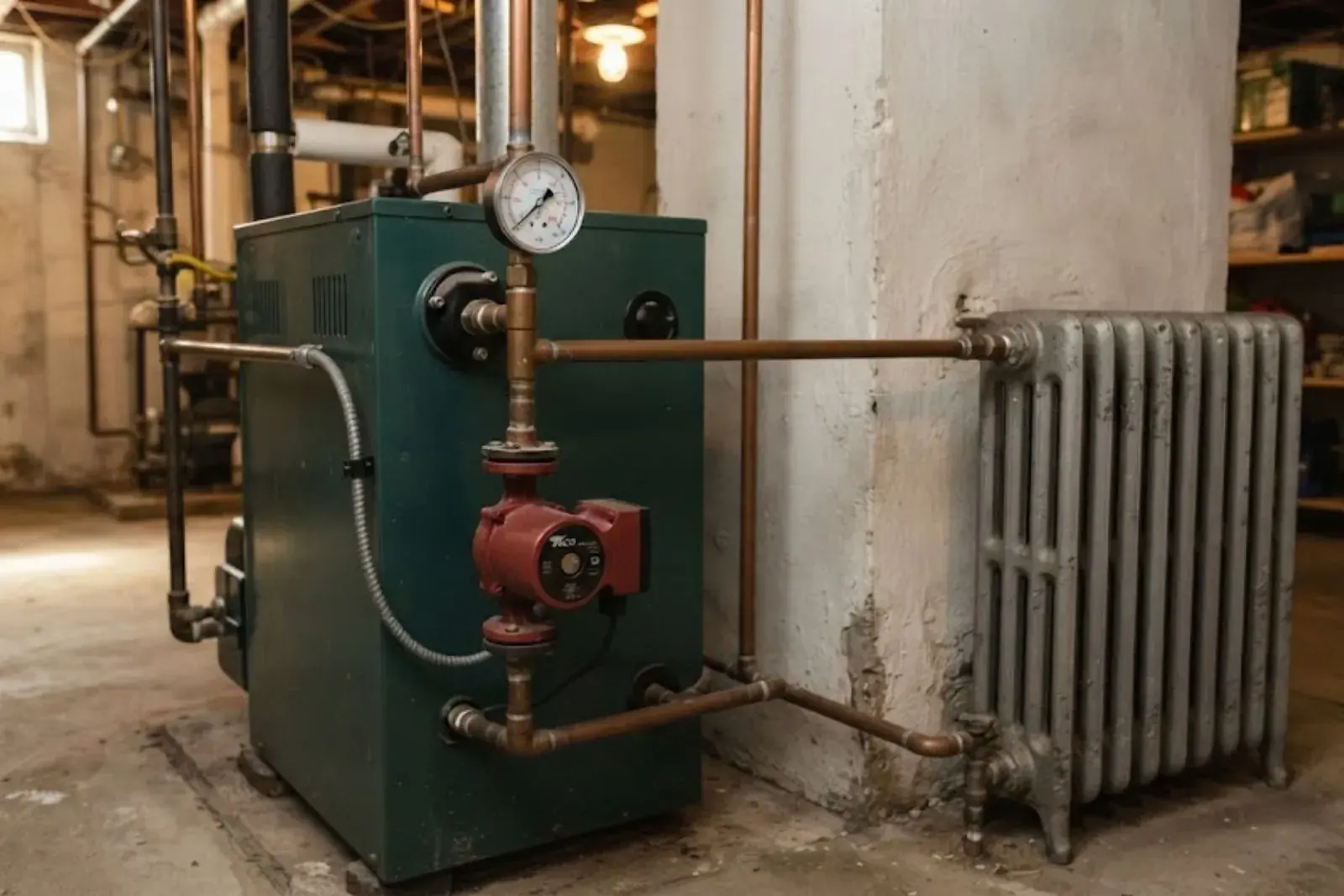
No heat or no hot water from a boiler: what to do while you wait
Boiler repair is the diagnosis and fix of a heating plant that has stopped making heat or hot water. We treat a no-heat call as an emergency in cold weather, and dispatch answers 24/7 with same-day appointments when a plumber is free.
While you wait, check the thermostat is set above room temperature and the boiler switch is on. Look at the pressure gauge, and read any code on the display. Do not open the burner cover or touch the gas valve.
Five checks you can do safely
If any of these fails, tell dispatch which one.
- Thermostat: set to heat, with a fresh battery if it has one.
- Power: the boiler switch and the circuit breaker are on.
- Pilot or ignition: look for a glow or status light without opening any cover.
- Pressure gauge: a reading near zero means the system has lost water.
- Reset: press the reset button once, as the label directs, and wait. If it locks out again, stop and call.
Gas smell and carbon monoxide
If you smell gas, leave the building right away and walk at least 350 feet from it. Do not touch light switches or doorbells, do not start a car and do not use a phone near the odor. Once you reach a safe distance, call PSE&G at 1-800-880-PSEG (7734) or 911. Reporting a gas leak costs nothing.
A carbon monoxide alarm is a separate warning. If it sounds, leave the building and call 911. Do not wait to see if it stops, and do not re-enter until responders say it is safe.
Common boiler faults
Most boiler calls fall into a handful of faults. Ignition failure leaves the burner dark. Low pressure stops the system from circulating, and a leaking relief valve points to pressure or a failed expansion tank. Noisy pipes, short cycling and a dead circulator pump make up most of the rest.
| Symptom | Likely cause | First step |
|---|---|---|
| No heat, burner silent | Ignition or flame sensor fault, or no gas | Check power and reset once, then call |
| Pressure gauge near zero | Water loss from a leak or a bad fill valve | Look for drips and do not keep refilling |
| Relief valve dripping | Over-pressure or a failed expansion tank | Call the same day, do not cap the valve |
| Banging or kettle noise | Scale or trapped air in the system | Note when it happens and tell the plumber |
| Boiler turns on and off quickly | Short cycling from an oversized unit or bad control | Check the thermostat and call |
| Warm boiler, cold radiators | Failed circulator or air lock | Bleed the radiators, then call if still cold |
Hot water, steam and combi boilers
A hot water boiler pushes heated water through pipes to radiators or baseboard with a circulator pump. A steam boiler boils water and sends steam up to radiators, which then return it as condensate. A combi boiler heats the home and makes domestic hot water in one unit.
Many older multi-unit buildings use a central boiler for every apartment. That shapes who you call first and how a repair is scheduled.
Radiators and baseboard heat
A radiator that is warm at the bottom and cold at the top holds air, and a small key on the bleed valve lets it out. Close the valve when a steady stream of water follows the hiss. On steam radiators, a stuck vent or a valve that sits partly shut can leave the radiator cold even though the boiler is working.
Baseboard pipes can also trap air. If bleeding does not help, a plumber checks the zone valve and the circulator.
Apartments and shared heat
In a building with a central boiler, call the landlord or superintendent first, since the owner controls the plant. Give them the unit number, when the heat stopped and whether neighbors are also cold. If the owner asks us to repair the boiler, dispatch books a plumber and we coordinate access to the boiler room.
Repair or replace
A part such as an igniter, a circulator or a relief valve is a normal repair. Replacement comes up when the heat exchanger leaks, the unit fails repeatedly or parts cannot be found. A plumber should give you both options and a clear price before work starts. For new equipment, see plumbing installation.
What boiler repair costs
Price follows the fault, not the brand. We give a clear price before work starts, after the plumber has seen the boiler.
Insurance rarely covers a worn-out part, but a sudden leak that damaged a ceiling may be covered. Photograph damage, call your insurer first and keep the invoice.
Want your real number? Call and describe the job.
Call (551) 249-3045What happens when you call
Tell us at once if you smelled gas.
Tell us what you see
Give the boiler type, the display code and the pressure reading.
Dispatch
The next open plumber is booked, same day when available.
Diagnose
The plumber checks power, ignition, pressure and the circulator.
Repair and test
You get the price first, and the system runs a full cycle before we leave.
Cold apartment, boiler down?
Call (551) 249-3045. Dispatch answers 24/7, and we book same-day appointments when a plumber is free.
More help near you
A leak at the boiler may need leak detection, and a failed pipe falls under burst pipe repair. We also serve Jersey City Heights with the same 24/7 dispatch.
Boiler questions
Yes. Dispatch answers 24 hours a day, and we book same-day appointments when a plumber is free. Tell dispatch if you smell gas.
The system may have a leak, or the fill valve may have failed. Do not keep adding water, since that hides the leak.
It means the system is releasing pressure. Do not cap it, and call the same day.
Call the landlord or superintendent first. The owner can authorize a plumber for the central boiler.
Yes. Use a radiator key, open the valve slowly and close it when water appears. If the radiator stays cold, call.
Leave the building and call 911. Do not go back in until responders clear it.
Still have a question? A dispatcher answers around the clock.
Call (551) 249-3045Public sources behind boiler repair
According to these official pages, the rules and safety steps mentioned here apply in New Jersey. Check them for your own address, since rules can change.
- New Jersey Department of Community Affairs, Uniform Construction Code general information: permit and inspection rules for plumbing work on existing buildings.
- NJ Division of Consumer Affairs, State Board of Examiners of Master Plumbers FAQ: who may perform plumbing work and what a licensed business must display.
- PSE&G, what to do if you smell gas: the leave-first steps and the gas emergency line.