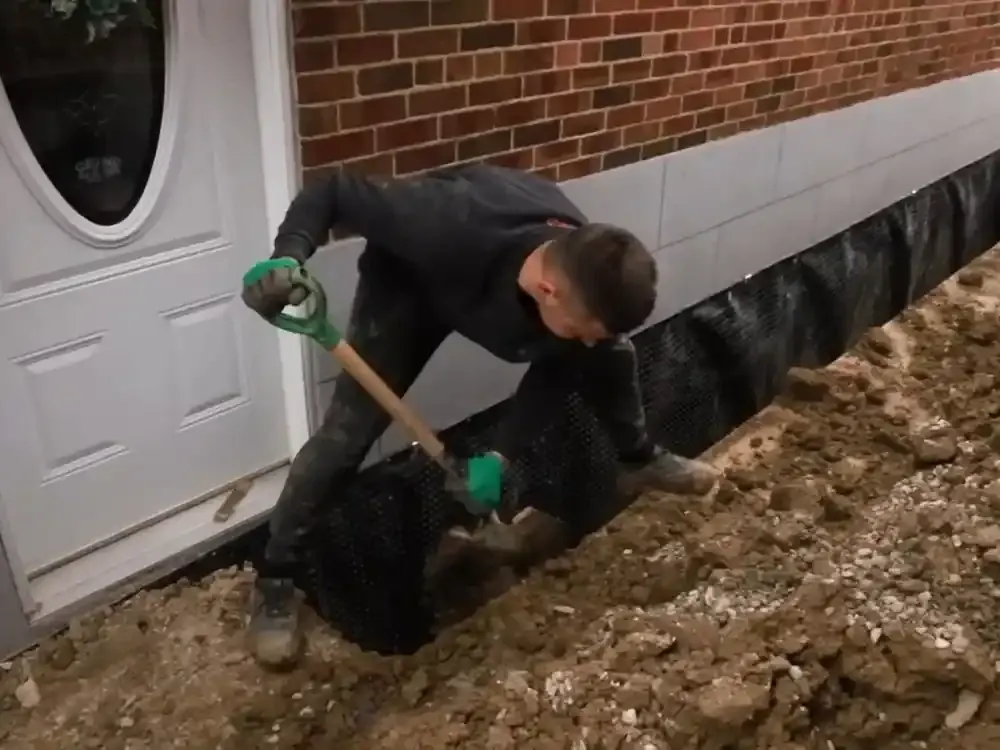
What waterproofing from the outside involves
Exterior waterproofing stops water at the foundation wall before it reaches the basement. A crew excavates down along the outside of the wall, cleans the surface and repairs cracks. They then apply a waterproof membrane or coating, add a drainage board and set a perimeter drain at the footing to carry water away.
Backfilling comes last, usually with gravel and soil, and the surface is restored. It is thorough because the barrier sits on the wet side of the wall. It is also the most disruptive method, since it needs digging along the entire wall that is being treated.
The parts of an exterior system
What goes in the trench
Each layer has a job, and skipping one weakens the rest.
- Excavation to the footing so the whole wall face can be reached.
- Crack repair and a cleaned, prepared wall surface.
- A membrane or coating applied to the foundation wall.
- A drainage board that lets water slide down the wall instead of pressing on it.
- A perimeter drain at the footing that carries water to a discharge point or a pump.
The perimeter drain is the part that ties into plumbing. It needs a place to send the water, either by gravity to a lower outlet or into a sump pit with a pump. That is why a good exterior job is planned together with the drain and discharge, not as a separate coating.
Why exterior work is often impractical on tight lots
Digging along a foundation wall needs room for machines, spoil and the crew. Many Union City buildings are attached to neighbors, sit at the sidewalk line or have a narrow side passage. In those cases the wall you most want to treat may not be reachable at all without crossing a property line or disturbing a shared wall.
We say often, not always, because every lot differs. A detached two-family with a rear yard may allow it where a row house cannot. A specialty contractor can inspect the site and tell you what access exists, and the Union City construction office can tell you which permits apply before any digging begins.
Interior alternatives
When the outside is off limits, the water can still be managed from the inside. An interior drain channel runs along the base of the wall, below or beside the slab. It catches water that enters at the wall and floor joint and guides it to a sump pit, where a pump sends it out. Our sump pump installation and repair page covers that part.
Interior systems do not stop water from reaching the foundation wall. They give it a controlled path so it does not spread across the floor. Sealing cracks, patching leaks and improving surface grading can reduce the load, but a pump and a good discharge route still carry most of the work.
| Approach | What it does | Disruption | Fit for tight lots |
|---|---|---|---|
| Exterior waterproofing | Blocks water at the outside face of the wall | Highest: excavation along the wall | Often limited by neighbors, sidewalks and access |
| Interior drain and sump | Collects water at the wall base and pumps it out | Moderate: slab cut inside the basement | Usually workable from inside the building |
| Drain and sump only | Pumps out water from an existing pit or floor drain | Low to moderate | Works where seepage is modest and the discharge is clear |
First confirm it is groundwater and not a plumbing leak
A damp basement can come from the ground or from a pipe, and the fix depends on which. Check whether the wet spot appears only after rain or snowmelt. If it shows up on dry days, a supply line, drain, water heater or boiler may be leaking.
Try this simple test. Close all fixtures, note the water meter reading and check it again after an hour or two without using water. If the dial still moves, you may have a leak that no waterproofing will fix. Also look at where the water enters, since drops on a pipe or a wet spot below a fixture point to plumbing, and a damp line along the base of the wall points to groundwater.
A quick way to sort the cause
This takes about an hour and can save you from paying for the wrong repair.
Watch the weather
Note whether the wet patch shows up only after rain or on dry days too.
Check the meter
Stop all water use, read the meter and read it again later to see whether it moved.
Inspect the pipes
Look at supply lines, drains, the water heater and the boiler for drips or stains.
Call for tracing
If the source is still unclear, a plumber can use leak detection tools to locate it.
If a pipe is the cause, our leak detection service locates it without opening more wall and floor than needed. Fixing the pipe often ends the dampness with no waterproofing at all.
Who does what: plumber and waterproofing contractor
Here is an honest limit. Exterior waterproofing, masonry repair and foundation work are specialty contractor jobs. A plumber handles drains, sump pumps, discharge piping, check valves, ejector pumps and leak tracing.
Many basements need both. A contractor may excavate and seal the wall while a plumber connects the perimeter drain to a pit, installs the pump and runs the discharge. Ask who is responsible for each piece, and make sure the permit covers the plumbing portion.
Local note: attached buildings and permits
Union City has historically been a city of brownstones and two-family homes, and it packs 26,455 housing units into about 1.29 square miles. Many of those buildings share walls with their neighbors. What this means for you: before anyone quotes an exterior job, find out whether the contractor can actually reach the wall they plan to treat, and if not, ask for an interior plan instead.
New Jersey's Uniform Construction Code requires a construction permit for work on existing buildings, including plumbing, while ordinary maintenance is exempt. A new drain, a sump pit or a discharge line is more than routine repair, so ask the Union City construction office what applies before the job starts. The permit also gives you an inspection of the piping, which protects you if the work is ever questioned.
Choosing a path
Start with the source. If a leaking pipe explains the water, fix it and see what remains. If groundwater is the cause, ask a waterproofing contractor whether exterior work is possible, and ask a plumber about the drain, pit and pump that any plan will need.
Our West New York and North Bergen pages show the neighboring areas we serve, where attached buildings and tight lots are common too. A sound plan matches the method to the building, not the other way around.
Want a plumber to check the drains and pump side?
Call the 24/7 line and describe where the water appears. A licensed plumber will tell you what a visit covers and give a clear price before work starts.
Exterior waterproofing questions
It treats the wall from the wet side, which is thorough. It is also more disruptive and often not possible on attached buildings, so interior drainage is the common alternative.
No. Exterior membrane and masonry work belong to a specialty contractor. A plumber handles the drain, sump pit, pump and discharge piping.
Check the water meter with all fixtures off and look for wet spots below pipes. A moving meter or a drip on a line points to a leak.
Sometimes it drains by gravity to a lower outlet. In a basement, it more often feeds a sump pit where a pump sends the water out.
Often it cannot, because a shared wall or sidewalk line blocks access to the foundation. A specialty contractor can confirm after a site visit, and the Union City construction office can advise on permits.
Public sources behind this guide
According to these official pages, the rules and safety steps mentioned here apply in New Jersey. Check them for your own address, since rules can change.
- New Jersey Department of Community Affairs, Uniform Construction Code general information: permit and inspection rules for plumbing work on existing buildings.
- NJ Division of Consumer Affairs, State Board of Examiners of Master Plumbers FAQ: who may perform plumbing work and what a licensed business must display.
- North Hudson Sewerage Authority, about the system: the towns it serves and its combined sewer network.