Does your building need a sump pump?
A building needs a sump pump when groundwater collects around or under the basement floor faster than it drains away. Typical signs are damp patches at the base of the wall, water seeping through the slab after rain and a musty smell that returns every wet spell. If the water is clear and shows up only after rain, groundwater is the likely source.
Sewage is a different problem with a different pump. If the water is cloudy, smells like a drain or comes up through a floor drain, the cause is a sewer backup or a lower fixture with no way to drain by gravity. Test the source first, because the wrong pump in the wrong place will not fix either one.
What a sump pump installation includes
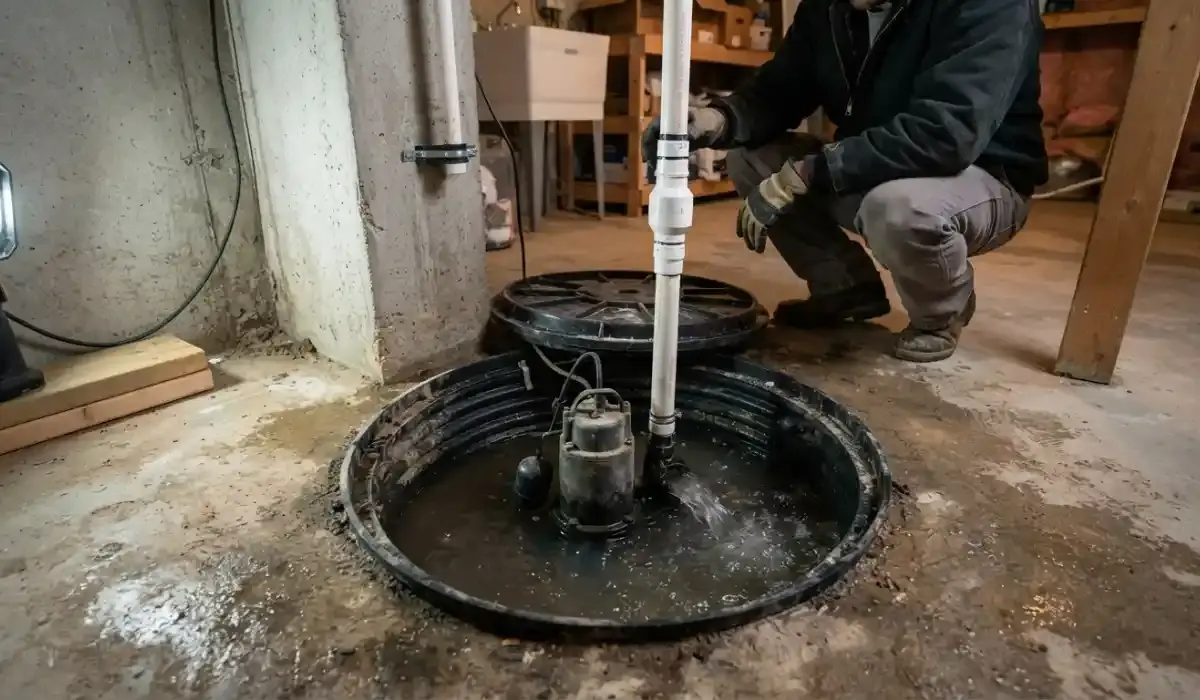
A sump system has five main parts. A pit is cut into the basement floor, usually a plastic or fiberglass basin sunk below slab level. The pump sits in the pit, a float switch turns it on as water rises, and a discharge pipe carries water out of the building. A check valve on that pipe stops water from flowing back into the pit when the pump shuts off.
The work starts with opening the slab, which means breaking concrete, digging the pit and setting the basin level. A good installer then tests the float, runs water through the system and checks every joint on the discharge line. Concrete work and some of the discharge routing may need permits, so ask the Union City construction office before the job begins.
What to ask before you agree to an installation
A clear answer to each of these tells you more than the pump brand does.
- Where will the water go when it leaves the building?
- Is there a check valve on the discharge line, and where does it sit?
- Is the pump on its own circuit, and who handles any electrical work?
- Is a battery backup included or priced separately?
- Who patches the slab afterward, and how long does the concrete need to cure?
Where the water goes in a dense block
Discharge is the hardest part of a sump job in a crowded neighborhood. In a house with a yard, a pipe can run outside and drop water well away from the wall. On a street of attached buildings there may be a sidewalk, a shared wall, a neighbor's lot or a public sewer, and each one has its own rules.
We do not state those rules here, because they depend on the property and the municipality. Before you plan a discharge route, ask the Union City building department what is allowed where you live. Never assume that a pipe pointed at the street or tied into a drain is acceptable, since sending groundwater into a sewer line can load the system.
| Pump type | What it moves | Typical location | Key point |
|---|---|---|---|
| Pit sump pump | Groundwater and rain seepage | Basement floor pit | Needs a clear discharge route to the outside |
| Pedestal pump | Groundwater from a shallow pit | Narrow or shallow pits | Motor sits above the pit, so it is easier to reach |
| Sewage ejector pump | Waste from a basement bath or laundry | Sealed basin near the fixture | Pushes waste up to the main drain line, not outside |
| Battery backup pump | Groundwater during a power failure | Second pump in the same pit | Needs periodic battery checks and replacement |
Ejector pumps for a basement bathroom
A bathroom below the level of the building drain cannot use gravity. A sewage ejector pump collects the waste in a sealed basin and lifts it to the sewer line above. This is not the same job as a sump pump, and the two should never share a pit.
An ejector system needs a sealed lid and a vent so gases escape safely. It also needs a check valve and a pump built to pass solids. Because it ties into the sanitary drain, the work needs a licensed plumber and likely a permit, so ask the construction office before you build the bath.
Power failures and battery backup
A pump is useless without electricity. Heavy storms are exactly the moments when power can drop and water rises, which is why a battery backup is worth discussing. A backup pump runs from a deep-cycle battery and takes over when the main pump or the grid fails.
A backup also needs care. Batteries lose capacity over time, chargers fail quietly and the unit may be smaller than the main pump. Ask your installer how long it should run, how to test it and when the battery should be replaced.
Local note: combined sewer and heavy rain
Union City is served by the North Hudson Sewerage Authority, whose system is a combined sewer. NHSA lists 107 miles of combined sewers, which means storm runoff and household waste share the same pipes. In a heavy downpour the public system can run full. What this means for you: a basement floor drain or ejector line that connects to it may slow down or back up, so a check valve on those lines matters as much as the pump itself.
Hoboken gives a sense of the scale. Hurricane Sandy in October 2012 flooded about 1,700 homes there, and seawater covered roughly half the city. Union City sits on the ridge of the Palisades, so a building here faces a different risk from tidal flooding, but the lesson transfers. Move stored items off a basement floor, put electrical equipment above the likely water line and test your pump before the rainy season, not during it.
Testing and maintaining the pump
Test a sump pump every few months. Pour a bucket of water into the pit until the float lifts, then watch that the pump starts, empties the pit and shuts off. Listen for grinding, rattling or a motor that runs but moves no water.
Clean the pit of silt and debris once a year, and check that the discharge pipe is clear and the outlet is not frozen or blocked. If the pump cycles often with no rain, groundwater may be higher than expected or a supply line may be leaking into the pit. A leak is a plumbing issue, and our leak detection page covers how we find one.
When a pump is not the whole answer
A sump pump removes water once it arrives. It does not stop it from entering, so a basement with constant seepage, cracked walls or a failing foundation needs more than a pit. In that case, read about basement waterproofing options, which can include interior drainage, sealing and exterior work done by a specialty contractor.
A plumber handles the pump, the discharge piping, the check valve and the sewage side. We do not do structural repair, masonry or electrical service. For nearby buildings, our Hoboken and West New York pages describe the areas we cover next to Union City.
Water in the basement and not sure why?
Call the 24/7 line and say whether the water is clear, gray or foul. A licensed plumber will tell you what the visit will cover before work starts.
Sump pump installation questions
A sump pump moves groundwater out of the building. An ejector pump lifts sewage from a basement bath or laundry up to the building drain.
Yes. It keeps pumped water from running back into the pit, which makes the pump cycle again and wear out faster.
Every few months, and again before the wet season. Pour water into the pit until the float lifts and confirm that the pump empties it.
It is worth discussing if your basement floods during storms. Ask the installer about run time and battery replacement.
That depends on the property and the town. Ask the Union City building department before you plan the route, and do not tie into a sewer line without approval.
Public sources behind this guide
According to these official pages, the rules and safety steps mentioned here apply in New Jersey. Check them for your own address, since rules can change.
- New Jersey Department of Community Affairs, Uniform Construction Code general information: permit and inspection rules for plumbing work on existing buildings.
- NJ Division of Consumer Affairs, State Board of Examiners of Master Plumbers FAQ: who may perform plumbing work and what a licensed business must display.
- North Hudson Sewerage Authority, about the system: the towns it serves and its combined sewer network.