The quick way to find a sprinkler leak
Start with the water meter. Turn off every tap and appliance, shut the sprinkler controller to off, and watch the meter's small leak dial for two minutes. If it keeps turning, water is escaping somewhere, and you can narrow it down by closing valves one at a time.
Then walk the property looking for a soggy patch, a sunken spot or a sprinkler head that sprays weakly. Those three clues, plus a meter that moves with everything off, answer the question for most outdoor leaks.
Be realistic: what outdoor water looks like in Union City
Union City has about 53,000 people per square mile across just 1.29 square miles, so big lawns with in-ground sprinklers are rare. What you find instead is a patch of grass behind a two-family home, a front planter, a courtyard, a rooftop garden or a shared building irrigation line. A leak in any of these wastes the same water and can stain a wall or run into a basement.
So this guide covers the systems people actually have here. A small-yard zone, a hose bib on the back wall and a drip line on a terrace all fail in similar ways, and the checks below work for each of them.
Where outdoor leaks hide in a dense city
- Hose bibs and outdoor spigots: a dripping spout or a leak inside the wall behind it.
- Small-yard sprinkler zones: a cracked head, a loose fitting or a split in buried tubing.
- Rooftop and terrace garden lines: drip tubing, connectors and the timer or tap that feeds them.
- Courtyard planters with a fed line: a fitting that has worked loose near the wall.
- Shared building irrigation: a main line serving several residents, often with one valve in a basement or utility room.
Signs your outdoor water line is leaking
Any one of these is worth a check. Two or more usually means a real leak.
- A patch of soil or paving that stays wet when it has not rained.
- Low pressure or weak spray at one or more heads, while indoor taps are fine.
- A water bill that rose with no change in how many people live in the unit.
- A sprinkler zone that runs but the ground near the valve box is soggy.
- A hissing sound near a hose bib or valve when everything is off.
- Damp plaster or a stain on an inside wall right behind an outside spigot.
The meter test with the system off
Water meters have a leak indicator, often a small triangle or star that spins when any water moves. With every fixture off, including the sprinkler timer, watch it for two minutes. A spinning indicator means a leak somewhere on the property side of the meter.
Now close the shutoff to the outdoor line and check again. If the dial stops, the leak is outdoors. If it keeps going, the loss is inside the building or on a different line. In a shared building the meter may serve several units, so ask the super which meter is yours before you read it.
Isolating zones one at a time
If you have a sprinkler controller with several zones, run them one at a time while you watch the meter. The zone that makes the dial move fastest, or that leaves the ground soggy, holds the problem. Look for a head that is cracked, a riser that has snapped or a fitting that has pulled apart.
For a drip line on a terrace, close the tap feeding it and check the meter again. A line that is leaking even with the timer off points to a stuck valve or a failed fitting at the connection.
| What you see | Likely source | Next step |
|---|---|---|
| Soggy patch near a sprinkler head | Cracked head or loose riser | Shut that zone off and check the head |
| Wet ground along a straight line | Split in buried tubing | Run each zone and dig only near the wet spot |
| Drip at a hose bib | Worn washer or packing | Replace the washer or the spigot |
| Damp wall behind an outside tap | Leak inside the wall | Close the shutoff and call a plumber |
| Meter moves with the system off | Leak on the line, not just a head | Close valves one at a time |
| Low pressure at all heads | Closed valve or a major leak | Check the valve, then the meter |
What a plumber adds that you cannot see
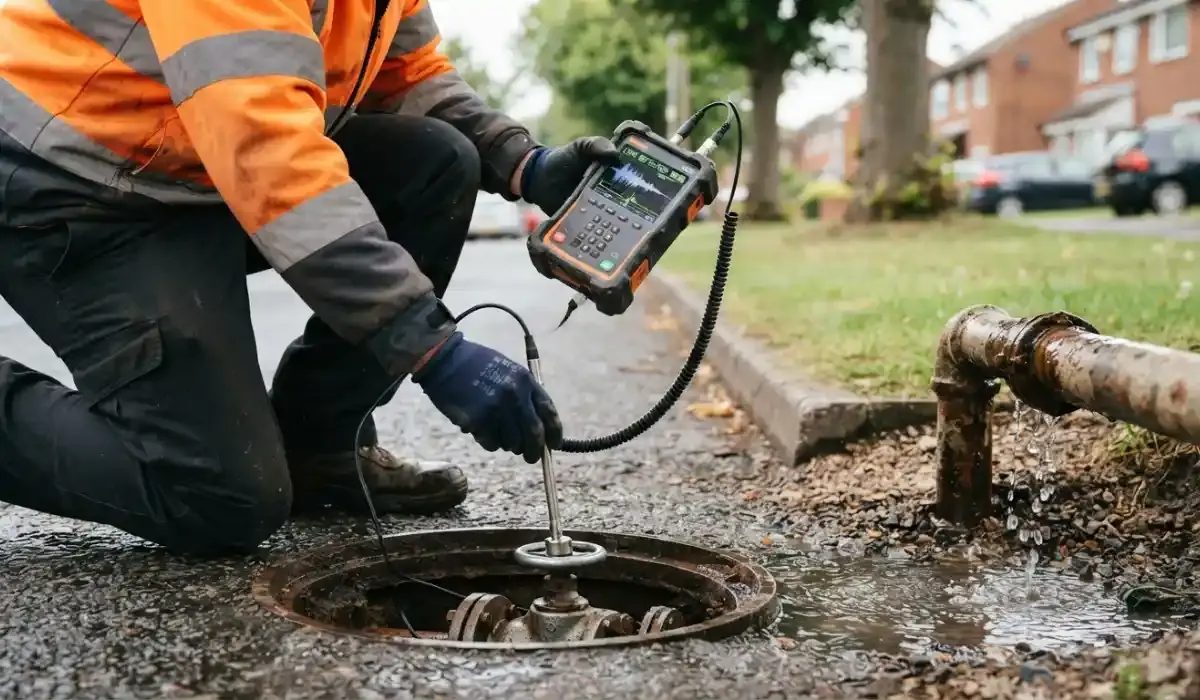
A plumber brings tools that find water without digging. Acoustic listening gear picks up the sound of a pressurized leak, and a pressure test shows whether the line holds. Our leak detection service uses these methods to point to the spot before any ground or wall is opened.
That matters in a dense city, where a trench can run into a foundation wall, a neighbor's line or a paved courtyard. Digging only at a confirmed spot is cheaper and less messy than guessing.
When to stop and call
Call if the meter keeps moving after you close the outdoor line, if a wall behind a spigot is wet, or if the leak is in a shared building line. Also call if you cannot find the shutoff, or if the pipe feeding the system looks old and worn. A line that is failing in several places may call for repiping instead of a patch.
If you want to add a new tap, a new zone or a better shutoff, that is a job for plumbing installation. Sprinkler systems usually need a backflow preventer, and test rules come from the water utility, so ask Veolia or the construction office which devices need annual testing.
Local note: Veolia, the meter and the rules
Veolia is the water provider for Union City, and its customer service line is (800) 422-0141. Ask for your account's usage history if the bill jumped, because the readings show whether the rise was gradual or sudden. A sudden jump with no change in use suggests a leak, and a gradual one may point to a slow drip.
You can also ask Veolia for the annual water quality report, but it is not needed for leak work. If a repair means cutting into a wall or changing a line, a construction permit is required in New Jersey for work on existing buildings, with an exemption for routine repairs. Ask the Union City construction office whether your fix counts as routine.
What affects the cost of a sprinkler leak repair
A single head or washer is a short visit. A buried split, a long run or a leak in a wall takes more time and more access work. Shared lines can add coordination with the building.
We give a clear price before work starts, so you can see the scope first. Nights and weekends fall under emergency dispatch hours, and a burst that floods a basement is a different call from a slow drip.
Nearby towns with the same small-yard setups
Similar compact yards and shared lines show up in our service areas of West New York and Weehawken. If you live near either town line, the same meter test applies. A short phone call can tell you whether the visit is worth booking.
Need help finding the leak?
Call the 24/7 line and describe the wet spot or the meter reading. A plumber will tell you what the visit involves.
Sprinkler leak questions
Close the shutoff to the outdoor line and recheck the meter. If the dial stops, the leak is outdoors. If it keeps spinning, the loss is inside the building.
Tell the building super first, since the line serves more than one resident. A plumber can find the leak, but the owner or association decides on the repair.
Yes. A steady drip wastes water around the clock, even when it seems minor. Replacing a washer is often a simple fix.
Routine repairs are generally exempt, while new work or changes to existing piping may need a construction permit. Ask the Union City construction office before work starts.
A hidden leak, a running toilet or a stuck irrigation valve can all do it. Do the meter test with everything off, then ask Veolia for your usage history.
Public sources behind this guide
According to these official pages, the rules and safety steps mentioned here apply in New Jersey. Check them for your own address, since rules can change.
- New Jersey Department of Community Affairs, Uniform Construction Code general information: permit and inspection rules for plumbing work on existing buildings.
- NJ Division of Consumer Affairs, State Board of Examiners of Master Plumbers FAQ: who may perform plumbing work and what a licensed business must display.