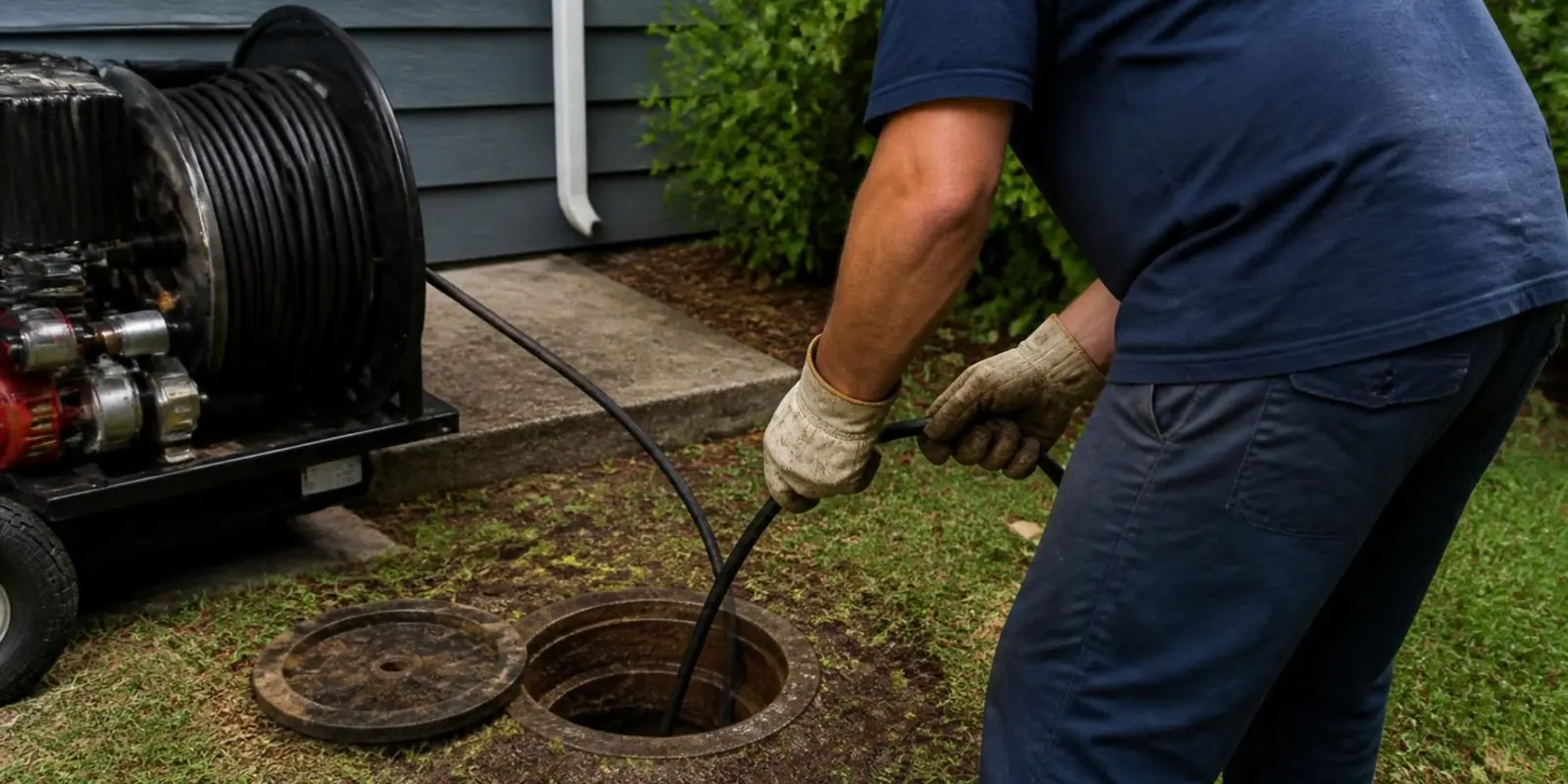
Sewer backup in the basement: first moves
A main sewer line that stops moving sends wastewater to the lowest opening it can find, which is usually a basement or ground-floor drain. Our 24/7 dispatch line takes these calls at any hour, and a licensed plumber can be booked same day when one is open.
Before anyone arrives, stop every source of water in the building, including toilets, showers, the washing machine and the dishwasher. Keep children and pets out of the wet area, because sewage carries bacteria. Do not try to clear the line with chemicals.
Signs the main line is blocked
A single slow sink is a branch problem. A pattern like this points to the main.
- Several fixtures back up or gurgle at once, not just one.
- A flush sends water or foul smell up the basement floor drain.
- The lowest toilet or tub fills with gray water when upstairs fixtures run.
- Cleaning one drain makes no difference to the others.
Main line versus branch drain
Every fixture has a short branch drain that joins a larger pipe, and those larger pipes gather into the main sewer line that leaves the building toward the street. A clog in a branch affects one sink or tub. A clog in the main affects everything that drains downstream of it.
This matters for the visit. If the problem is a branch, ordinary drain cleaning is enough. If the main is blocked, the plumber needs a longer cable or a jetter and a way into the pipe.
Cleanouts: the door into the line
A cleanout is a capped opening in the sewer line, usually near the foundation wall, in a basement or in a utility area. It lets the plumber feed a cable or a jetting hose directly into the main without removing a fixture. Without a cleanout, the plumber may have to pull a toilet or work from a roof vent, which takes longer.
If you know where your cleanout is, clear space around it before the visit. If you do not, ask the super or owner, and tell dispatch when you call. Never open a cleanout while the line is full, because wastewater can pour out.
How the line gets cleaned
The plumber chooses the tool from what the blockage seems to be. A powered cable with a cutting head breaks through soft clogs and small roots. A jetter, which sprays high-pressure water, scours grease and scale off the pipe wall and flushes debris toward the street.
Afterward, a camera pass confirms the line is clear and shows whether cracks, offset joints or roots caused the clog. That last step separates a one-time stoppage from a pipe that will fail again.
| Tool | Handles | Watch for |
|---|---|---|
| Cutting cable | Soft clogs, paper, small roots | May leave grease along the pipe |
| Hydro jetter | Grease, scale, heavy buildup | Camera first on fragile pipe, see hydro jetting |
| Camera | Confirms flow and shows damage | Cannot clear the line on its own |
Public sewer or your lateral: who owns the problem
The pipe from your building to the street connection is called a lateral. Beyond the connection, the public sewer belongs to the North Hudson Sewerage Authority, which serves Union City, Hoboken, Weehawken and West New York. Their system is combined, so storm runoff and household waste share the same pipes.
If several buildings on your block back up at once, especially during heavy rain, the public line may be the cause. Report that to the Authority at 201-963-6043 (weekdays, 9 to 5), and still call us so the plumber can confirm your lateral is clear. If our camera shows the lateral is open, you have a clear record to give the Authority.
Repeat blockages and roots
A line that clogs once may have had a bad week. A line that clogs every few months has a reason, and the camera usually finds it: roots entering a joint, grease coating the wall, a belly where water pools, or a broken section catching debris.
Roots are the most common repeat cause in older lines. Cutting them restores flow, but they return until the joint is repaired or lined. If the camera shows a failing joint, the next step is sewer line repair, and a recorded sewer inspection gives you something concrete to show an owner or insurer.
What sewer line cleaning costs
Cost depends on the blockage and how reachable it is, and the price is stated before work begins. The main factors:
Many home policies exclude backups unless you added water backup coverage. Ask your insurer before cleaning up a flooded basement, and keep photos, receipts and the plumber's report.
Want your real number? Call and describe the job.
Call (551) 249-3045What happens on the call
The visit adds a camera step whenever the backup has happened before.
Tell dispatch
Say which floor is affected and whether sewage has reached the floor.
Plumber arrives
The plumber checks the lowest drains and locates the cleanout.
Line is cleared
Cable or jetter opens the main and the plumber tests flow at several fixtures.
Camera follow-up
A pass through the line shows the cause and whether repair is likely.
Sewage backing up in your building?
Call the 24/7 line now. Stop water use and tell dispatch which floor is wet.
After the line is open
Put wipes in the trash, keep cooking fat out of the drain and ask your super how often the main has been serviced. Buildings with shared stacks do better with a planned cleaning than an emergency one at midnight.
West New York buildings sit on the same combined system, so this advice carries over. Urgent fixes for stubborn grease or roots are covered under hydro jetting.
Sewer line cleaning questions in Union City
Yes. Dispatch answers 24/7 and books same-day appointments when a plumber is free. Mention sewage on the floor so the call is handled first.
No. Union City is on the public sewer, so septic tanks do not apply. Your building connects to the North Hudson Sewerage Authority system through a lateral.
Report it to the North Hudson Sewerage Authority at 201-963-6043 and call us as well. The plumber can check whether your own lateral is clear.
Look near the foundation wall, in the basement or in a utility closet for a capped pipe. If you cannot find it, ask the owner or super.
Roots, grease, a low spot or a cracked pipe are the usual causes. A camera run shows which one, so you fix the cause instead of paying for repeat cleaning.
It can carry bacteria, so keep people and pets away and avoid touching it. Wear gloves and boots if you must go in, and call right away.
Still have a question? A dispatcher answers around the clock.
Call (551) 249-3045Public sources behind sewer line cleaning
According to these official pages, the rules and safety steps mentioned here apply in New Jersey. Check them for your own address, since rules can change.
- New Jersey Department of Community Affairs, Uniform Construction Code general information: permit and inspection rules for plumbing work on existing buildings.
- NJ Division of Consumer Affairs, State Board of Examiners of Master Plumbers FAQ: who may perform plumbing work and what a licensed business must display.
- North Hudson Sewerage Authority, about the system: the towns it serves and its combined sewer network.