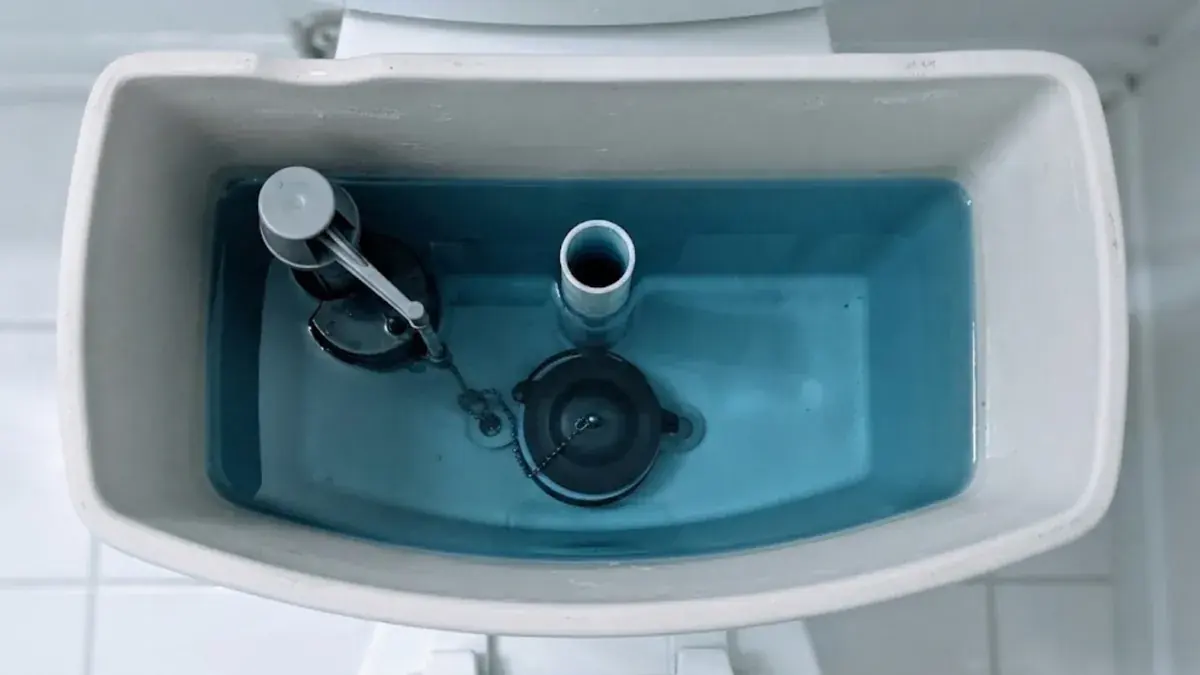
What the refill tube does inside your toilet
The refill tube is a thin flexible hose that runs from the fill valve to the overflow tube, the tall open pipe in the middle of the tank. After each flush it sends a small stream of water down that pipe to refill the bowl. The rest of the water goes into the tank through the fill valve itself.
When the tube works, you never think about it. When it slips out of its clip or cracks, the toilet may hiss, run on or never quite finish filling.
Symptoms that point to the fill tube
What a bad or loose tube looks like
Lift the tank lid and look before you touch anything. The tube is usually easy to see.
- A hissing sound after the flush that does not stop.
- Water that runs constantly into the overflow tube.
- A bowl that stays low after flushing, so the toilet seems to flush weakly.
- A tube that has fallen off the overflow pipe and sprays against the tank wall.
- A cracked, brittle or kinked hose, or one that has come loose from the fill valve.
Fixing a tube that has slipped or cracked
If the tube has simply slipped off, push it back onto the small nipple on the fill valve, and re-seat its other end in the clip on the overflow tube. Make sure the end sits above the water line inside the tank, not below it. A tube dipping into the tank water can pull dirty water back into the supply.
A cracked tube is a cheap part, and most hardware stores stock universal ones. Cut the new tube to length so it does not kink, and clip it in. Flush twice and watch for the hiss to stop.
When the fill valve needs replacing
A fill valve wears out. The tell is a tank that keeps trickling after it should have shut off, a valve that rattles, or a float that no longer lifts cleanly. Replacing the valve takes some tools but not many, and the parts are standard.
Close the shutoff behind the toilet, flush to empty the tank, and disconnect the supply line. Remove the old valve, set the new one at the right height and reconnect. Open the shutoff slowly and look for drips at every joint.
Replacing a fill valve
Allow about an hour if this is your first valve.
Shut off the water
Turn the valve behind the toilet clockwise until it stops.
Drain the tank
Flush once and sponge out what remains.
Disconnect
Loosen the supply nut under the tank, then the locknut holding the valve.
Set the new valve
Fit it to the manufacturer's height and tighten the locknut by hand plus a quarter turn.
Reconnect and test
Attach the supply, clip on the refill tube and turn the water on slowly.
| What you notice | Likely cause | What to do |
|---|---|---|
| Hiss after the flush | Loose or cracked refill tube, or a worn fill valve | Reseat the tube, then replace the valve if needed |
| Water runs into the overflow tube | Water level set too high, or a failing valve | Lower the float, replace the valve |
| Tank refills every few minutes with no flush | Flapper leaking into the bowl | Do the dye test, replace the flapper |
| Weak flush, low water in the bowl | Refill tube out of place | Reseat the tube |
| Water on the floor around the base | Supply line or tank bolt leak | Shut off the toilet and call a plumber |
When it is really the flapper
Many running toilets blame the fill tube when the flapper is the real cause. The flapper is the rubber seal at the bottom of the tank. If it warps or gets stiff, tank water leaks into the bowl and the fill valve keeps topping it up.
A dye test settles it. Put a few drops of food coloring in the tank, wait fifteen minutes without flushing, and look at the bowl. Color in the bowl means the flapper is leaking, not the tube. Our toilet repair page covers the other parts a plumber checks.
When to stop and call a plumber
Call if the tube is in place and the toilet still runs, if the shutoff valve will not close, or if you see water on the floor you cannot trace. A shutoff that is stuck or corroded can snap if forced, and that turns a small repair into a flooded bathroom.
Also call if the tank is cracked, the bolts are leaking, or the fixture is loose on the floor. A slow leak you cannot find may call for leak detection. And if a faucet in the same bathroom drips, faucet repair is a separate fix worth doing at the same visit.
Local note: shared risers and your bill
Many Union City toilets sit in multi-unit buildings where one riser feeds several floors. If the shutoff behind your toilet will not close, shutting water off elsewhere may cut service to your neighbors. Check with the building super before you touch a riser valve, and let residents know first.
What this means for you: a running toilet is also a money problem, because the water keeps flowing whether or not anyone uses it. Veolia provides the water, and you can ask for your account's usage history to see whether the running showed up on the bill. If the building pays the water bill, tell the super anyway, since the cost lands on someone.
What affects the cost of a fill tube or valve repair
A tube is the smallest repair. A new fill valve costs more in time and parts, and a failed shutoff valve or a cracked tank raises the scope. Older fixtures can be harder to match with standard parts.
We give a clear price before work starts. Ask whether the quote includes the shutoff valve and the supply line, since replacing them while the tank is open prevents a second visit.
Serving the neighborhood
We handle toilet calls in Union City and nearby towns such as West New York and North Bergen. The same repair applies on both sides of Kennedy Boulevard. A short call is enough to sort out whether you need a part or a visit.
Toilet still hissing or running?
Call the 24/7 line and describe the sound and the water level. A plumber will tell you what the visit involves.
Fill tube questions
It clips onto the top of the overflow tube and points down into it. The end should stay above the tank water line.
No. Tape slips and glue can clog the tube. A new tube is a small part and a better fix.
The fill valve may be worn, or the flapper may be leaking so the valve keeps refilling. Try the dye test before you replace parts.
Use the small valve behind the toilet first. That affects only your fixture. Ask the super before touching any riser valve, because it may cut service to other units.
It can be, since the water keeps moving all day. Fixing it quickly stops the waste.
Public sources behind this guide
According to these official pages, the rules and safety steps mentioned here apply in New Jersey. Check them for your own address, since rules can change.
- New Jersey Department of Community Affairs, Uniform Construction Code general information: permit and inspection rules for plumbing work on existing buildings.
- NJ Division of Consumer Affairs, State Board of Examiners of Master Plumbers FAQ: who may perform plumbing work and what a licensed business must display.
- North Hudson Sewerage Authority, about the system: the towns it serves and its combined sewer network.