How to tell if you have a water leak
The fastest test is the water meter. Turn off every tap, appliance and ice maker, then watch the meter's small leak indicator for two minutes. If it moves, water is leaving the pipes somewhere, even if nothing looks wet.
If the meter holds still, the leak may be intermittent, or your bill may have another cause. The checks below work in order, from the cheapest to the most involved, and each one rules out a source.
The meter test, step by step
Run the meter test
This takes about ten minutes and needs no tools.
Stop all water use
Close taps, pause the dishwasher and washer, and make sure nobody flushes.
Find the meter
Look in the basement, a utility room or a street box. In a shared building, ask which meter is yours.
Read the leak dial
A small triangle or star spins when any water moves. Note its position.
Wait and recheck
Give it two minutes, then look again. A moving dial means a leak.
Close the main and look again
If the dial stops after you shut the main, the leak is inside the building.
The toilet dye test
Toilets leak silently more than any other fixture. Lift the tank lid, drop in a few drops of food coloring and leave it without flushing for ten to fifteen minutes. If color shows up in the bowl, the flapper is letting water through.
A toilet leak can waste a surprising amount of water each day while sounding like nothing at all. If the dye test fails, our toilet repair page explains what a plumber replaces, and it is often a small part.
Check under sinks and around the water heater
Open each cabinet under a sink and feel the supply lines, the shutoff valves and the trap with a dry paper towel. A damp towel, a mineral crust or a swollen cabinet floor tells you where water has been.
Look around the water heater too. Wet insulation on the pipes, rust at the fittings, or moisture at the base of the tank all point to a slow leak. A leaking tank cannot be patched, so if the water is coming from the tank itself, call the same day.
Wall, ceiling and floor signs
Signs of a leak you can see or feel
None of these proves a leak alone. Several together make a strong case.
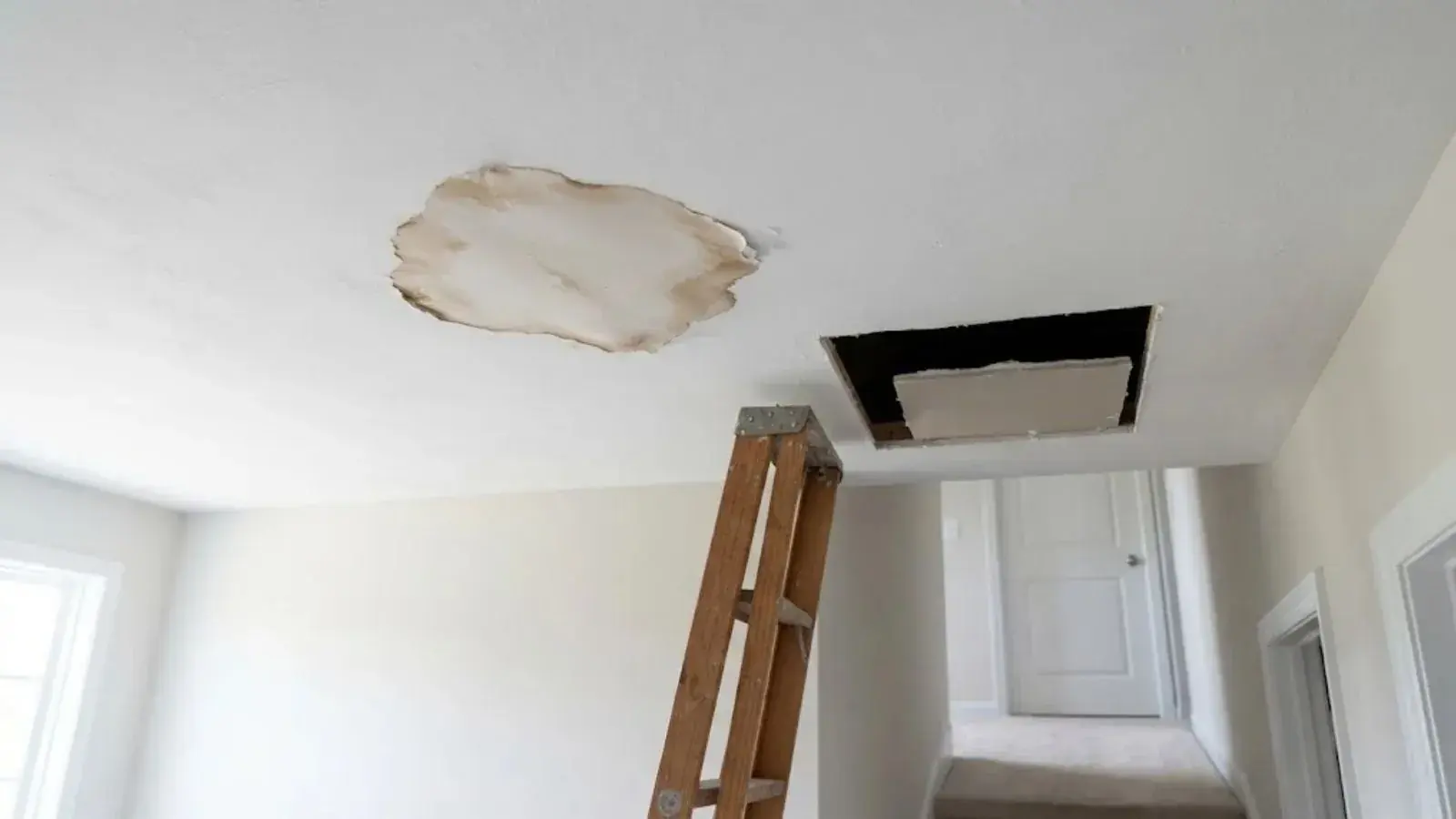
- A brown or yellow ring on a ceiling, especially under a bathroom or kitchen above.
- Paint that bubbles, peels or cracks on a wall with no other cause.
- A warm spot on the floor, which can mean a hot water line leaking under the surface.
- A musty smell in a closet or cabinet that gets worse over days.
- A hissing or dripping sound inside a wall when the house is quiet.
- A floor that feels soft, springy or cold and damp in one patch.
| Sign | Likely source | Next step |
|---|---|---|
| Meter dial moves with all taps off | Leak on a supply line, in a wall or under a slab | Close the main, then call a plumber |
| Color in the bowl after the dye test | Worn flapper or fill valve | Replace the part or book toilet repair |
| Brown ring on a ceiling | Leak from the unit or pipe above | Tell the super and shut off water to the fixture above |
| Warm floor patch | Hot water line under the floor | Shut off the heater supply and call |
| Damp cabinet under a sink | Supply line, trap or faucet base | Tighten fittings or replace the line |
| High bill with no visible wet spot | Hidden or running leak | Run the meter test, then ask for your usage history |
High bills, and what the numbers can tell you
A bill that climbs for several months with no change in how many people live in the unit often points to a slow leak. A bill that jumps in one cycle points to something that failed suddenly, such as a stuck toilet flapper or a split line.
Ask Veolia for your account's usage history. The readings show the pattern, and the pattern helps you decide where to look first. Veolia customer service is (800) 422-0141.
When to shut the main, and when to wait
Shut the main if water is spraying, a ceiling is sagging, or the leak keeps spreading after you close the nearby valve. A pipe that has burst needs fast action, and our burst pipe repair page covers what to do while you wait. Turn off electricity only if you can reach the panel without standing in water.
If the leak is slow and you can contain it with a bucket, you can wait for a planned visit. The main shutoff may be in a basement or a hallway closet, and it is worth finding before you need it.
What to tell dispatch in a multi-unit building
Say which floor you are on and which fixture is leaking. Tell the dispatcher whether the ceiling below you is stained, whether neighbors have the same problem and whether you can reach a shutoff. Mention if several apartments share the same riser, the vertical pipe that feeds many floors.
If you cannot shut off water without cutting service to other residents, say so. The plumber can plan for a building shutoff and bring the right valve keys. Calling the super before the plumber arrives often saves time.
Local note: dense buildings and the super
Union City has about 53,000 people per square mile, and most of them live in attached buildings with shared walls, floors and risers. A leak in one unit often shows up in another. A stain on your ceiling may come from the apartment above, not from your own plumbing.
What this means for you: call the building super early. He or she can open the main valve, reach the unit above and tell you which pipes serve which floors. Veolia is the water provider, so you can ask it for your account's usage history if the bill looks wrong. A repair that opens a wall or changes a line may need a permit, so ask the Union City construction office.
Cost drivers for finding and fixing a hidden leak
The price depends on how much of the system a plumber has to open. A visible leak under a sink is quick. A wall leak, a slab leak or a shared riser takes more detection work and more repair access.
We give a clear price before work starts. Listening gear, pressure tests and camera checks find the spot first, so walls are opened only where needed. Nights and weekends fall under emergency dispatch.
Neighboring towns, same checks
The same steps apply across the area. If you live just over the line, see our pages for West New York and Hoboken.
Cannot find the leak?
Call the 24/7 line and tell us what you saw. A plumber will tell you what the visit involves.
Water leak questions
Yes, and it is one of the most common cases in attached buildings. Tell the super right away, and photograph the stain so the plumber can see how it changes.
Two minutes is enough for a first look. If the dial barely moves, try again after thirty minutes with everything still off.
Not usually. Close the shutoff at the fixture first, then ask the super about a riser valve. Cutting service to other residents is a decision for the building.
Yes. A running toilet wastes water around the clock and raises the bill. The repair is often a small part.
The building owner or association is generally responsible for shared pipes. A plumber can trace the leak, and the super coordinates access and shutoffs.
Public sources behind this guide
According to these official pages, the rules and safety steps mentioned here apply in New Jersey. Check them for your own address, since rules can change.
- New Jersey Department of Community Affairs, Uniform Construction Code general information: permit and inspection rules for plumbing work on existing buildings.
- NJ Division of Consumer Affairs, State Board of Examiners of Master Plumbers FAQ: who may perform plumbing work and what a licensed business must display.