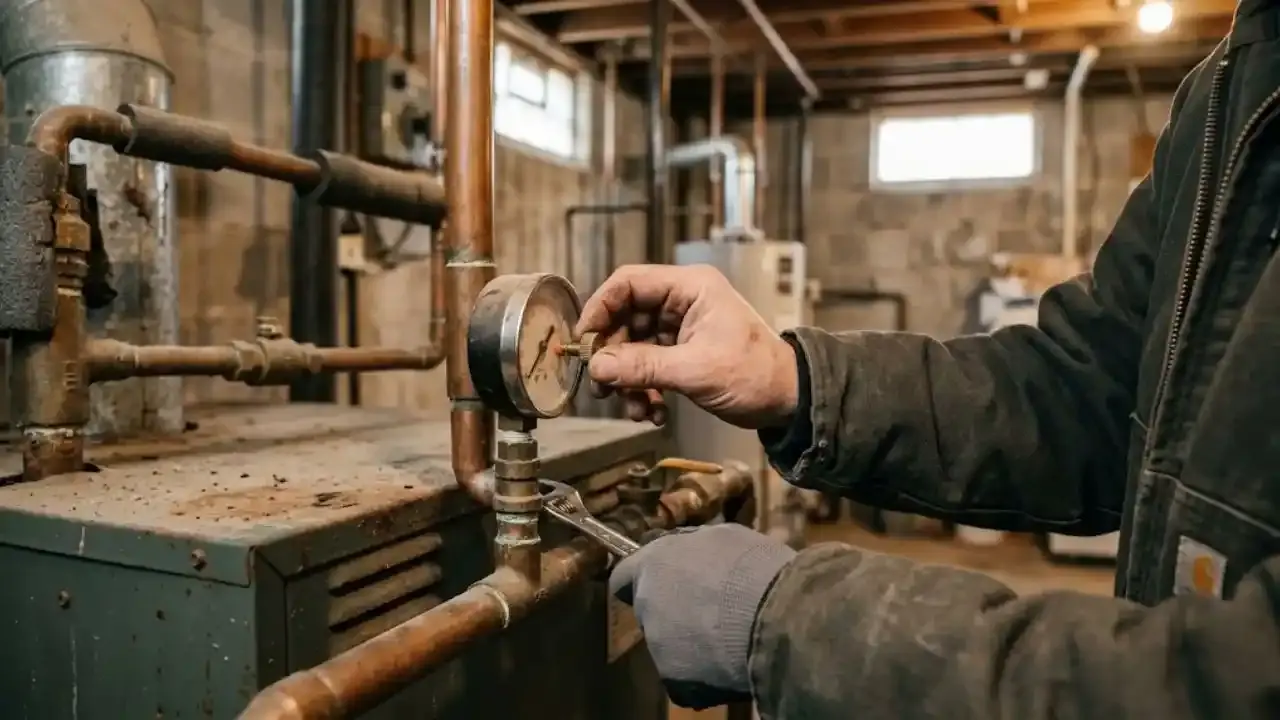
No heat: the first five minutes
When a boiler stops heating, start with the simple things. Check the thermostat, the power switch, the pressure gauge and the area around the boiler for leaks. These four checks solve a surprising share of no-heat calls and take only a few minutes.
Do them in order and stop if anything feels unsafe. A smell of gas, a hissing pipe or water pooling around electrical parts means you leave the work to a professional. The sections below explain each check and where it ends.
The owner's no-heat checklist
Each step is safe for an owner. None of them requires opening the boiler.
Thermostat
Set it to heat, raise it a few degrees above room temperature and replace dead batteries.
Power
Confirm the boiler switch is on and the breaker has not tripped, but only if the panel is dry and dark spaces are lit.
Pressure
Read the gauge. A reading near zero often means low water, and a very high one means the system needs service.
Reset once
Press the reset button one time if your boiler has one. If it locks out again, stop.
Look for leaks
Check pipes, valves and the floor around the boiler for drips, rust or a wet patch.
Resetting more than once is a trap. A boiler locks out for a reason, and repeated resets can hide a fault or build up unburned fuel. If one reset does not restore heat, a plumber should look at it.
If you smell gas or suspect carbon monoxide
Gas safety comes before any repair. If you smell gas, leave the building immediately and move at least 350 feet away. Do not flip light switches, press doorbells, start a car or use a phone near the odor. Once you are at a safe distance, call PSE&G at 1-800-880-PSEG (7734) or 911. Reporting a gas leak carries no charge.
Carbon monoxide has no smell, so a detector is the only warning. If an alarm sounds or anyone feels dizzy, headachy or sick near the boiler, get everyone outside into fresh air and call 911. Do not go back in to troubleshoot, and do not rely on a plumber's schedule for a gas or CO emergency.
What to leave to a plumber
Some jobs are not for owners. Opening the burner compartment, working on gas valves, cleaning a combustion chamber, replacing a circulator pump or draining and refilling a system all need a trained professional. So does anything involving the flue and vent, since a blocked vent can push exhaust into the living space.
We are plumbers, and that has limits. We handle boilers, piping, valves, circulators and leaks. For electrical panel work or a utility meter issue, other trades or the utility step in. A good visit starts with a clear explanation of which category your problem falls into.
| Symptom | Likely cause | First step |
|---|---|---|
| No heat, boiler silent | Thermostat, power or tripped switch | Check the thermostat and boiler switch, then reset once |
| Radiators cold at the top | Air trapped in the system | Call a plumber if bleeding valves do not help |
| Pressure gauge near zero | Low water or a leak | Look for leaks, then call before refilling |
| Loud banging or kettling | Scale, low water or a failing pump | Turn the boiler off and call |
| Water around the boiler | Leaking valve, joint or tank | Shut off power if dry access allows, then call |
| Pilot or burner will not stay lit | Dirty sensor, vent trouble or gas supply | Reset once, then call, and leave if you smell gas |
Common faults behind a dead boiler
Most boiler faults fall into a few groups. Ignition parts such as the pilot, igniter or flame sensor wear out and stop the burner. Circulator pumps and zone valves fail and leave some rooms cold. Low water cutoffs, pressure relief valves and expansion tanks can all shut a system down or leak.
Old scale and sludge also build up in a boiler that has run for many seasons. Water treatment helps, and so does an annual tune-up before the heating season. A leak in a supply pipe near the boiler is a plumbing issue too, and our leak detection page explains how we trace one.
Repair or replace?
A repair makes sense when the fault is one part and the rest of the boiler is sound. Replacement is worth discussing when failures keep coming back, the heat exchanger leaks, parts are hard to find or the system runs far less efficiently than it should. Ask the plumber to explain the choice in plain terms and put the repair and replacement costs side by side before you decide.
Replacement is also a permit question. New Jersey's Uniform Construction Code treats ordinary repairs as routine, but replacing a boiler is more than maintenance, so ask the Union City construction office what applies before the work begins.
Why no heat is urgent for tenants
A cold apartment is more than an inconvenience. Cold rooms are hard on children, older adults and anyone with a health condition, and frozen or cold pipes can burst. If the weather is cold and the heat is out, treat it as urgent rather than waiting for the next day.
In a rented unit, the first call usually goes to the landlord or building super, since they control the boiler and decide who is sent. Tell them in writing as well as by phone so there is a record. If you own the building or the landlord asks you to arrange repair, our 24/7 dispatch can send a plumber, and a pipe that has already burst falls under burst pipe repair.
Local note: PSE&G, shared heat and permits
PSE&G supplies gas in Union City, and it is the number to call for a gas odor. Report a smell from outside the building, 350 feet away or more. What this means for you: do not wait to confirm it with your own nose or a plumber, because the utility has the equipment to find a leak and shut off service, and the call is free.
Union City packs 26,455 housing units into about 1.29 square miles, and many older buildings use one central boiler for several apartments. A fault in that boiler affects every unit at once, so one tenant's report can start a repair for the whole house. If your neighbors are cold too, say so when you call the super, since it points to the central equipment rather than your own radiator.
Getting it fixed
If your checks do not bring the heat back, call and describe what you found. Tell dispatch the thermostat setting, the gauge reading and any noises, leaks or error lights. That lets the plumber bring the likely parts and plan the repair.
We also serve nearby towns, including North Bergen and Jersey City Heights. The same checklist applies there. If the boiler also feeds your hot water, the water heater repair page covers the related symptoms.
Boiler still cold after the checklist?
Call the 24/7 line and tell the dispatcher what you checked. A licensed and insured plumber will explain the visit and give a clear price before work starts.
Boiler repair questions
Press it once. If the boiler locks out again, something is wrong, and repeated resets can hide a fault. Call a plumber.
A reading near zero can mean a leak, and adding water without finding it wastes water and can damage the boiler. Look for leaks and call before refilling.
If you rent, call the landlord or super first, since they control the boiler. Call 911 or PSE&G first for a gas smell or a carbon monoxide alarm.
A tune-up before the heating season helps catch worn parts, scale and vent problems. Ask the plumber what it covers.
A central boiler belongs to the owner, so the landlord or super arranges the repair. Tenants should report the outage in writing and phone the super right away.
Public sources behind this guide
According to these official pages, the rules and safety steps mentioned here apply in New Jersey. Check them for your own address, since rules can change.
- New Jersey Department of Community Affairs, Uniform Construction Code general information: permit and inspection rules for plumbing work on existing buildings.
- NJ Division of Consumer Affairs, State Board of Examiners of Master Plumbers FAQ: who may perform plumbing work and what a licensed business must display.
- PSE&G, what to do if you smell gas: the leave-first steps and the gas emergency line.