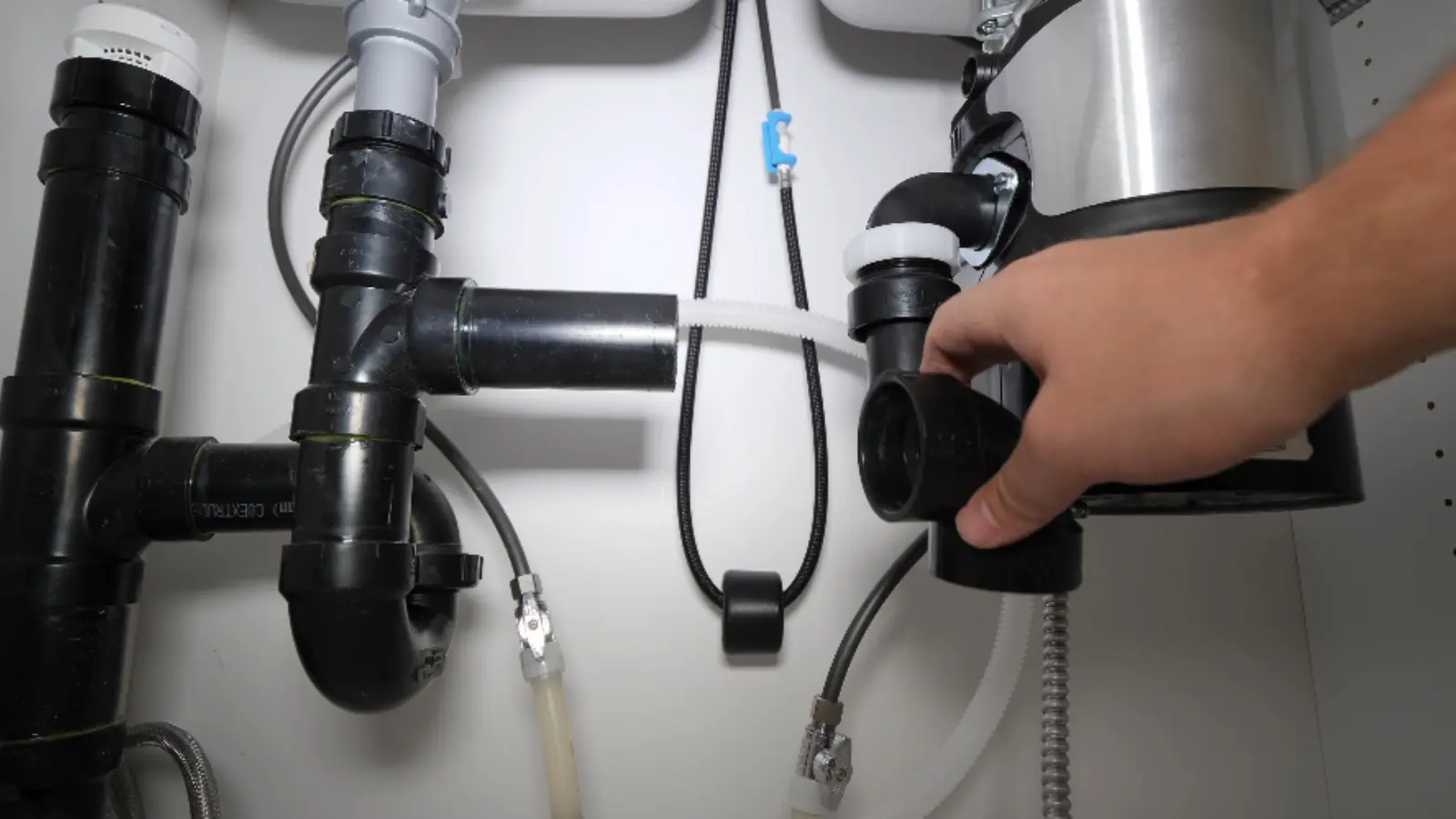
Disposal jammed, humming or leaking right now
A disposal that hums and will not spin, or leaks under the sink, is an emergency when it is the only kitchen sink you have. Our dispatch line is open 24/7, and we book same-day appointments when a plumber is free. Safety comes before the repair.
Turn off the wall switch and unplug the unit or switch off its breaker before you touch anything. Never put your hand into the disposal, even when it is off. Use tongs or pliers to remove anything visible.
Signs the disposal itself has failed
The sound a disposal makes tells you most of what is wrong.
- A loud hum with no grinding, which usually means the blades are jammed.
- No sound and no hum when the switch is on, even after the reset button is pressed.
- Water dripping from the body, the sink flange or a hose on the side.
- Grinding sounds that include metal, which can mean a spoon or bone is stuck inside.
Reset button and hex key: what an owner can safely do
With the power off and the unit unplugged, look under the disposal for a small red or black reset button. Wait ten minutes if the motor is hot, then press it in. Many units have a hex-shaped socket in the bottom plate that fits a quarter-inch hex key, or the wrench that came with the disposal.
Work the key back and forth until the blades turn freely. Then restore power and run cold water as you flip the switch. If the unit trips again, hums or leaks, stop and call. Repeated resets can burn out the motor.
Leaks from the flange, the body or the dishwasher hose
Where the water appears tells you the cause. Water around the sink flange at the top means the mounting seal or putty has failed. Water dripping from the disposal body usually means a cracked housing or a worn internal seal, and that is a replacement, not a repair.
Water at the side hose usually means the dishwasher hose connection is loose or the clamp has failed. Run the dishwasher briefly and watch the connection to confirm. A dishwasher drain connected to a disposal can also back up if the knockout plug was never removed, so mention that to the plumber.
A clogged sink that is really a drain problem
If the sink fills with gray water and the disposal runs but nothing leaves, the clog is past the disposal. Grease coats the drain line over months and finally stops the flow. A plumber clears the trap arm and the line behind it with a cable. See drain cleaning for how that works, and call us if other fixtures are also slow.
Replace or repair the disposal
A jammed unit with a healthy motor is a quick repair. A disposal with a cracked body, corroded housing or a motor that hums and burns out is better replaced. The age of the unit also matters, because a repair on an old model may be followed by another failure soon after.
| Problem | Repair makes sense | Replace makes sense |
|---|---|---|
| Jam from a bone or utensil | Clear it, reset and test | Blades bent or the unit is already old |
| Humming, no spin | Free the plate with a hex key | Motor fails again after a reset |
| Leak at the sink flange | Reseat with new seal or putty | Mounting parts are cracked |
| Leak from the body | Not repairable | New disposal |
| Dishwasher hose leak | Replace the hose or clamp | Not usually needed |
Disposal installation basics
Installing a disposal combines three trades. The plumber sets the mounting flange, hangs the unit and connects the drain and dishwasher line. A qualified person handles the electrical connection, either a plug into an outlet or a hardwired circuit, because we do not do electrical work. Many disposals use a switch on the wall. An air switch, a small button on the countertop, is also an option, and it avoids drilling a new wall box.
Bring the new disposal if you bought one, and tell us the sink type. Stainless sinks and stone countertops use different flanges.
What not to put down a disposal
Disposals handle soft food scraps, not everything that fits. Cooking grease, coffee grounds in bulk, eggshells, rice, pasta and potato peels build into a paste that clogs the trap. Bones, fruit pits, corn husks and fibrous stalks can jam the blades. Run cold water before, during and after each use so scraps move down the line.
In buildings with a shared stack, whatever one household sends down the sink eventually reaches the pipes everyone uses.
What disposal repair costs
The price depends on the repair you need, and we give a clear price before work starts. These factors set the total:
A disposal worn out from use is not an insurance claim. A sudden leak that floods the cabinet or floor may be, so take photos and keep the invoice.
Want your real number? Call and describe the job.
Call (551) 249-3045What happens when you call
Disposal visits move quickly when the cause is a jam or a loose hose.
Make it safe
Dispatch reminds you to switch off and unplug the unit and keep hands out of it.
Book the visit
We schedule the next open plumber, same day when one is free, and explain the price basis.
Diagnose
The plumber checks the motor, the seals and the connections, and tests the drain behind it.
Fix or replace
You see the options and approve the work before it begins.
Disposal stuck, humming or leaking?
Call the 24/7 line now. Switch the unit off at the wall, keep your hands out and tell dispatch what you see.
When the leak is bigger than the disposal
Water under a kitchen sink can also come from a failed faucet supply, a stop valve or a drain trap. If the cabinet floor is soaked, read about faucet repair and ask for a full check under the sink. We dispatch to Jersey City Heights as well.
Garbage disposal questions in Union City
Yes. Dispatch is open 24 hours a day, every day, and we book same-day visits when a plumber is free. Switch off the unit first and tell dispatch what it is doing.
No. Turn it off at the switch and unplug it or flip its breaker, then use tongs to remove anything. Never reach in, even when you think the power is off.
It restores a motor that tripped on overload. Press it after the unit cools, and if it trips again, call a plumber instead of resetting repeatedly.
The blades are probably jammed. With power off, turn the hex socket on the bottom with a quarter-inch hex key until it moves freely.
Check the sink flange at the top, the body, and the dishwasher hose at the side. The location tells the plumber what to bring.
Yes. An air switch is a countertop button that starts the unit, and it is a common alternative to a wall switch.
A qualified person does the electrical connection. The plumber handles the mounting, the drain and the dishwasher hose.
Still have a question? A dispatcher answers around the clock.
Call (551) 249-3045Public sources behind garbage disposal repair
According to these official pages, the rules and safety steps mentioned here apply in New Jersey. Check them for your own address, since rules can change.
- New Jersey Department of Community Affairs, Uniform Construction Code general information: permit and inspection rules for plumbing work on existing buildings.
- NJ Division of Consumer Affairs, State Board of Examiners of Master Plumbers FAQ: who may perform plumbing work and what a licensed business must display.