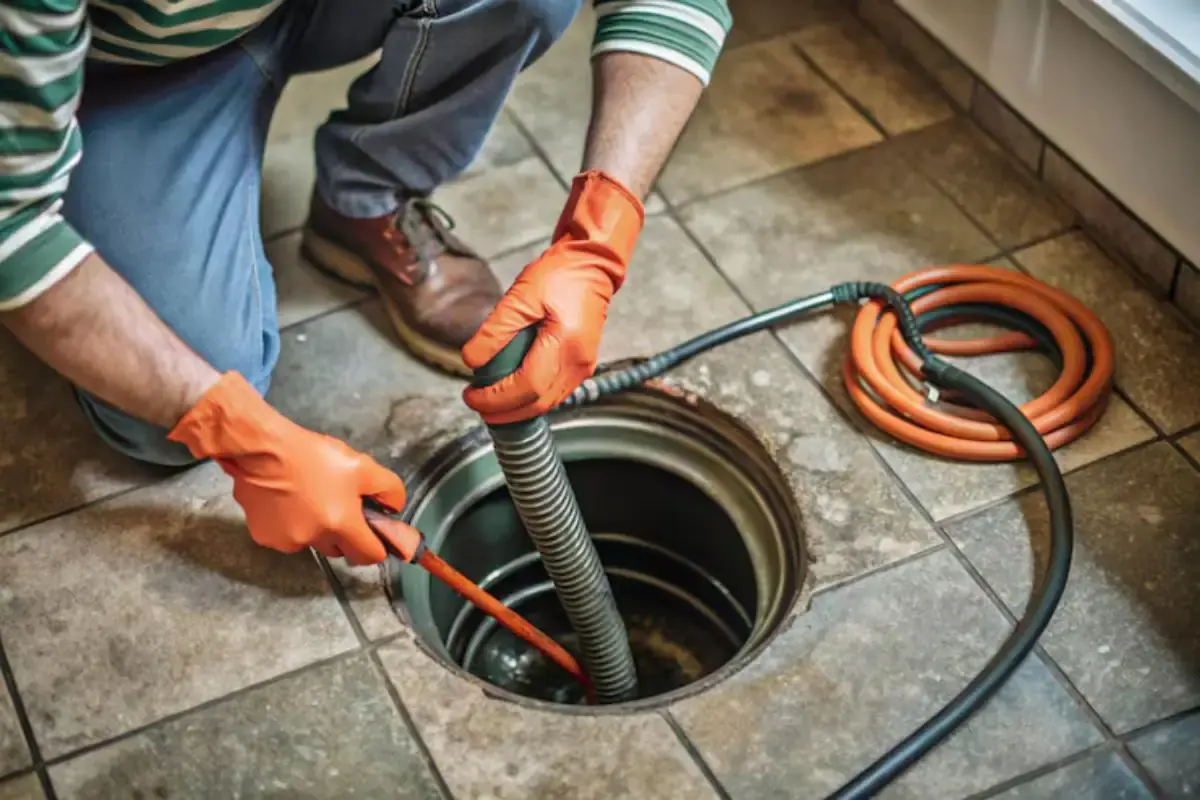
What a drain snake does and when it helps
A drain snake is a flexible steel cable with a corkscrew tip that you feed into a drain and turn. The tip hooks a clump of hair or breaks up soft debris, and you pull it out or push it through. It works best on a clog close to the opening, in a single sink, tub or shower.
It does not scrape a pipe clean or remove grease along the pipe walls. A snake opens a hole through the blockage, and the line can clog again if the build-up around the hole is still there.
The four main types of drain snake
- Hand auger: a short hand-cranked cable in a drum, good for sinks, tubs and showers.
- Toilet auger: a short cable inside a rigid tube with a rubber guard, made for toilet traps without scratching the porcelain.
- Drum snake: a longer cable in a drum, often with a crank, for a drain line that runs farther back.
- Power cable machine: a motor-driven cable on a larger reel, used by plumbers for main lines and stacks.
| Drain | Best tool | Notes |
|---|---|---|
| Bathroom sink or tub | Hand auger | Remove the stopper first, since hair collects there |
| Kitchen sink | Hand auger or drum snake | Grease may need cleaning, not just a hole |
| Toilet | Toilet auger | A regular snake can scratch the bowl |
| Shower | Hand auger | Go slowly past the strainer and the trap |
| Floor drain or main line | Power cable | Better done by a plumber |
How to use a hand snake safely, step by step
Using a hand auger
Wear gloves and eye protection. A snake can fling dirty water.
Clear the area
Remove the stopper or strainer and put a bucket and towels under the trap.
Feed the cable
Push the tip into the drain until you feel resistance.
Turn and advance
Crank the handle clockwise and push forward with gentle pressure.
Hook and pull
When it catches something, pull back slowly and clean the cable.
Flush with hot water
Run hot water for a minute to carry away what is left.
Go slow. If the cable stops at a bend, do not force it, because you can kink the cable or scrape a pipe. Back it out a few inches and try again at a different angle.
What not to do
Common mistakes that make a clog worse
Chemicals are the one most people try first, and the one that most often goes wrong.
- Pouring drain chemicals first. They can sit in the pipe and splash on you when you start working.
- Forcing the cable past a bend or a fitting that will not give.
- Snaking a toilet with a sink auger, which can scratch the bowl.
- Running the snake hard in a very old or brittle pipe.
- Using a snake on a line that backs up in several fixtures at once.
- Leaving a stuck cable in the drain and walking away.
Older buildings add a wrinkle. Many Union City kitchens and baths sit in multi-unit buildings with older drain lines, and you rarely know what material is behind the wall. Treat any cable with care, and if it feels like it is catching on something solid and not moving, back out instead of pushing harder.
Keep a bucket and old towels close, since a kitchen trap holds greasy water. Wipe the cable as you pull it out, because it carries whatever it hooked. A cable stored wet in a cabinet will rust, so dry it before you put it away.
When to stop and call a plumber
Stop if the cable will not go in, if it comes back with a foul smell, or if water rises in a second fixture while you work. Slow drains in several fixtures, a gurgle in the toilet when the sink drains, and a sewer smell all point to a bigger line. A snake will not fix those.
Also stop if the same drain clogs again within weeks. A repeat clog means the cause is further down or built up on the walls. That is a drain cleaning job, often with a camera look first.
Snake, jetting or camera: how they differ
A snake opens a hole. Jetting uses high-pressure water to scour the pipe walls clean, and a camera shows what is inside without cleaning anything. Plumbers often pick based on what the line looks like.
If the pipe is greasy or scaled, hydro jetting usually does more than a snake. If the cause is unclear, a camera run tells you before you pay for the wrong job.
| Method | What it does | Best for | Limits |
|---|---|---|---|
| Snake | Punches through or hooks the clog | Hair, soft debris close to the drain | Leaves wall build-up behind |
| Hydro jetting | Scours the pipe wall with high-pressure water | Grease, scale and roots | Needs a sound pipe |
| Camera inspection | Shows the pipe's condition | Repeat clogs and unknown causes | Does not clear anything |
Local note: combined sewers and shared stacks
Union City is served by the North Hudson Sewerage Authority, which runs a combined sewer system. Storm runoff and household waste share the same pipes, so a heavy rain can slow drains across a block without any fault in your plumbing. If a drain slows during a storm and clears afterward, the cause may be the public system, and a snake will not help.
In multi-unit buildings, several apartments often feed one vertical stack. A clog in the stack shows up in the lowest unit first, usually as water coming up a floor drain or tub. What this means for you: if neighbors report the same problem, stop snaking, tell the building super and call a plumber for the stack. The Authority takes sewer reports on weekdays at 201-963-6043.
What affects the cost of clearing a clog
The cost depends on how far the clog sits and which tool the line needs. A fixture trap is quick, while a main line or stack takes machinery and time. Access matters too, since a cleanout makes the work easier.
We give a clear price before work starts. Nights and weekends fall under emergency dispatch, so tell us if the drain is backing up into living space.
Service in nearby towns
Our plumbers also work in Hoboken and Weehawken, which share the same sewer authority. The advice above applies there too. A short call can sort out whether a snake is the right tool.
Clog won't budge?
Call the 24/7 line and tell us which drains are slow. A plumber will tell you what the visit involves.
Drain snake questions
It can, if you force it or use it in old, brittle pipe. Turn gently, never push hard past a bend, and stop if it will not advance.
The city is on a combined sewer, so storm runoff and household waste share pipes. A slowdown that clears after the storm points to the public system, not your line.
No. Chemicals can sit in the pipe and splash when you work. Try a plunger or snake first.
Use a toilet auger, which has a rubber guard to protect the porcelain. A sink snake can scratch the bowl.
If several units on the same stack back up, or the lowest floor drain overflows, the stack is shared. Tell the super and call a plumber.
Public sources behind this guide
According to these official pages, the rules and safety steps mentioned here apply in New Jersey. Check them for your own address, since rules can change.
- New Jersey Department of Community Affairs, Uniform Construction Code general information: permit and inspection rules for plumbing work on existing buildings.
- NJ Division of Consumer Affairs, State Board of Examiners of Master Plumbers FAQ: who may perform plumbing work and what a licensed business must display.
- North Hudson Sewerage Authority, about the system: the towns it serves and its combined sewer network.